
EV Charger Installation in Oxnard
A Level 2 charger turns an overnight charge into a sure thing instead of a race against the clock, but where your panel sits matters more in Oxnard than you might expect. Many of the city’s homes have their main panel on the opposite side of the house from the garage, which changes how, and where, the new circuit actually gets run.
You’re in good hands. Our team will follow up promptly.
Why the Wiring Route Matters More Here
In a lot of Oxnard’s single-story homes, running new wire from the panel to a front-attached garage means crossing the length of the house, and interior walls aren’t always a practical path. When that’s the case, an attic route, rather than tearing into finished walls, is often the more efficient and less invasive solution.
Before any of that, the real first question is whether your panel’s amperage can support a dedicated EV circuit at all, which is why we always start with a load calculation rather than assuming.
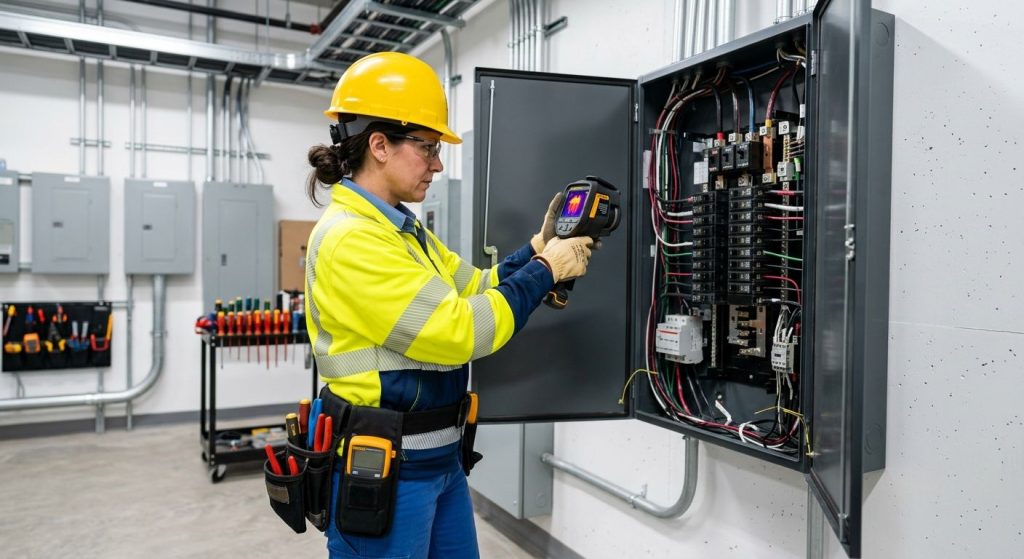
What an EV Charger Installation Includes
- Load calculation to confirm your panel can support a dedicated EV circuit
- Routing planning specific to your home’s layout, including attic runs where a wall route isn’t practical
- Installing a dedicated breaker sized to your charger and circuit length
- Pulling correctly rated conductors for continuous EV charging load
- Testing the charger under full load before we leave
We cover charger types, amperage options, and general installation steps on our EV Charger Installation service page.
FOR HOMEOWNERS
A Recent Oxnard EV Charger Installation
A homeowner wanted a 48-amp EV charger installed in their home’s front attached garage, but the main panel was located on the opposite side of the residence, making an interior wire run cost-prohibitive. We engineered a route through the attic space instead, using 1-inch EMT conduit and pulling #6 AWG THHN copper wire to handle the continuous 60-amp circuit requirement, accounting for the 80% continuous load rule.
The installation used a 60A 2-pole breaker, 1-inch EMT conduit, and a heavy-duty hardwire terminal, and we tested continuous current draw at 48A output, finding voltage dropped only 1.2% over the 70-foot run.
The owner can now recharge their vehicle at full speed overnight, safely and without a single wall opened up.
Before adding a large new load like an EV charger, some homeowners also opt for an Electrical Safety Inspection in Oxnard to confirm the rest of the panel and wiring is ready for it.
EV Charger Installation Pricing in Oxnard
| Charger Type | Starting Price | Notes |
|---|---|---|
| Level 1 (standard outlet-based) | From $300 | Slower charging, minimal wiring changes |
| Level 2 (240V, most common) | From $400 | Requires a dedicated circuit; price rises with run length |
| Long/attic conduit run (panel opposite side of house) | From $400 plus distance | Common configuration in Oxnard; final price depends on run length and routing method |
Final pricing depends on site conditions, materials, and permit requirements. Call for a free on-site estimate.
What Oxnard Customers Say
“Had a hardwired EV charging station installed on our driveway wall. Excellent cabling work and very clear instructions on how to monitor charging speeds.”
“Super fast turn-around from estimate to installation. Now we charge overnight at full speed without any issues.”
Serving Oxnard and Nearby Ventura County
For general coverage of this city, see our Oxnard page, or the Ventura County hub.
Common Questions About EV Charger Installation in Oxnard
What if my garage is on the opposite side of the house from my panel?
This is common in Oxnard, and it usually means routing the circuit through the attic instead of tearing into interior walls, we’ll plan the most efficient path during your visit.
Do I need a permit for a home EV charger in Oxnard?
Yes, adding a new dedicated circuit requires a permit, which we handle as part of the installation.
Does a longer wire run affect charging performance?
Only minimally if sized correctly, our recent installation with a 70-foot run saw just a 1.2% voltage drop, well within normal range.
Level 1 or Level 2, which should I choose?
Level 2 suits most daily drivers since it fully charges overnight, Level 1 is fine for lower-mileage or occasional use.
For company-level questions, see our general FAQ.
Schedule Your Service Today
Tell us what you need, and our team will get in touch to discuss your project and
help you take the next step.
You’re in good hands. Our team will follow up promptly.