
Table of Contents
- Preserving San Francisco’s Heritage with Modern Electrical Systems
- Understanding Electrical Systems in Historic San Francisco Buildings
- Navigating Electrical Codes for Historic San Francisco Properties
- Steps for Electrical Restoration in San Francisco’s Historic Homes
- Working with the San Francisco Planning Department for Electrical Upgrades
- Frequently Asked Questions About Historic Electrical Restoration in San Francisco
- Your Trusted Partner for Historic Electrical Restoration in San Francisco
Preserving San Francisco’s Heritage with Modern Electrical Systems
When undertaking historical restoration in San Francisco, updating electrical systems is a critical step that must balance modern safety with architectural integrity. San Francisco’s iconic Victorian, Edwardian, and Craftsman homes often contain outdated knob-and-tube or aluminum wiring that requires careful replacement to avoid damaging original lath and plaster walls.
We specialize in providing dependable, affordable high-quality electrical services in San Francisco tailored to these unique properties. Our fully trained technicians route new wiring through existing chases whenever possible, minimizing wall damage and preserving your home’s historic character. Modern electrical panels can be installed in basements, closets, or unobtrusive locations, keeping main living areas visually authentic. Safety upgrades like GFCI outlets and arc-fault circuit interrupters integrate seamlessly, often positioned behind furniture or within original cabinetry to remain hidden from view.
While historic masonry restoration in San Francisco focuses on the building’s exterior, interior electrical upgrades are equally vital for safety and functionality. The San Francisco Planning Department provides guidelines for exterior modifications such as service mast placement and meter box positioning, ensuring compliance with preservation standards. We navigate these regulations on your behalf so every upgrade meets both code requirements and historic district expectations.
As Licensed Local Electricians You Can Trust, we offer free consultations to assess your historic property’s electrical needs and plan code-compliant upgrades that respect its architectural legacy. All work meets or exceeds electrical codes and industry standards, with no hidden fees. Contact us to discover how modern electrical systems can safeguard your heritage home without compromising its timeless appeal.
By blending modern safety standards with preservation best practices, we ensure your historic home meets today’s demands. Next, we’ll examine how our panel upgrades can be tailored for vintage properties.
Understanding Electrical Systems in Historic San Francisco Buildings
The charm of historical restoration San Francisco projects captures the imagination, with ornate Victorian facades and intricate architectural details that define many of the city’s most beloved neighborhoods. In our years working throughout California, we have learned that behind those elegant period features often lurk electrical systems installed when Thomas Edison was still refining the lightbulb. Homes built before 1950 frequently contain knob-and-tube wiring, aluminum wiring, or cloth-insulated cabling — each one a hidden fire hazard that silently threatens the structure’s integrity. Properties such as the Haas-Lilienthal House, a Queen Anne landmark standing since 1886, continue to function with original-era electrical infrastructure, demonstrating exactly how long-lived these obsolete systems can be when left unaddressed. We know that preserving the historic character of these buildings is vital, but so is protecting the safety of the families and tenants who live inside them.
Early twentieth-century electricians relied on knob-and-tube wiring, a method that separates ceramic knobs and tubes to route conductors through open air. The system was not designed for today’s appliance loads, and the lack of a dedicated ground wire creates a serious shock risk. Equally problematic is aluminum wiring, which experienced a surge in use during the mid-1960s but develops oxidation that loosens connections and raises the probability of arc-fault fires. Our inspectors also frequently encounter cloth-insulated cables whose protective jacket has grown brittle and crumbled, leaving bare conductors exposed inside wall cavities. Any one of these conditions justifies a full upgrade, and San Francisco code typically requires complete replacement rather than partial repairs when the original system is no longer safe. We approach each project with the understanding that the structural fabric of a historic masonry restoration San Francisco project deserves wiring that meets modern safety standards without compromising period authenticity.
The following comparison table highlights the most common wiring systems we find in older San Francisco properties and explains why our team consistently recommends upgrading to modern copper NM cable:
| Comparison of Old vs Modern Wiring in Historic SF Properties | |||
|---|---|---|---|
| System Type | Safety Concerns | Upgrade Requirements | Cost Consideration |
| Knob-and-Tube | Fire hazard, insufficient capacity | Full replacement required | Higher upfront investment, value preserved |
| Aluminum Wiring | Oxidation, loose connections, fire risk | Often complete replacement or COP-alum connectors | Moderate; dependent on scope |
| Cloth-Insulated Wiring | Brittle, degraded insulation, exposed conductors | Full rewiring to modern standards | Comparable to knob-and-tube replacement |
| Modern Copper NM Cable | Very low; meets current code | Standard for new installations, no special treatments | Competitive; no hidden fees with upfront pricing |
Each legacy system introduces a distinct safety liability that becomes more acute as the building ages, yet copper NM cable eliminates those risks while complying fully with current NEC requirements. When we rewire a vintage home, we pay close attention to plaster walls, crown moldings, and original millwork, ensuring that the finished rooms retain the visual character owners love. Our licensed electricians also coordinate closely with craftspeople handling brick tuckpointing San Francisco restorations, because an electrical upgrade often runs parallel to broader structural improvements on period properties.
Upgrading the wiring in a historic property is one of the most impactful investments a San Francisco owner can make, delivering peace of mind, improved fire safety, and a system that reliably powers modern electronics. Our team embraces the challenge of working within older homes, and our NO HIDDEN FEES approach means you see exactly what the work will cost before we start. Beyond our historic property expertise, we also provide residential electrical services in San Clemente for customers managing vintage homes in that coastal community. Safety is our #1 priority, and with our Licensed Local Electricians You Can Trust on the job, we complete every rewiring project to the highest standards of workmanship while respecting the distinctive charm of your historic San Francisco building.
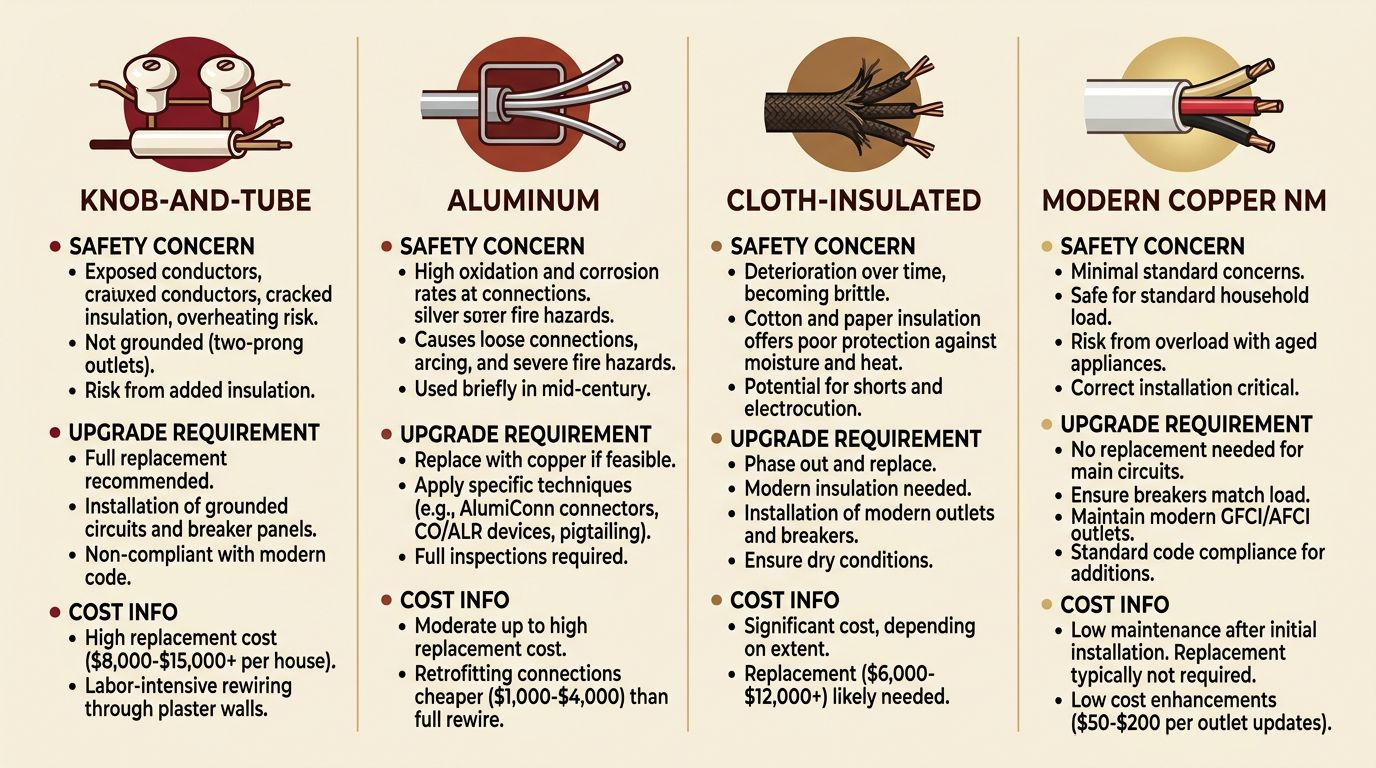
Comparison of old and modern wiring systems for historic San Francisco buildings.
Navigating Electrical Codes for Historic San Francisco Properties
When undertaking historical restoration in San Francisco, electrical code compliance is one of the most complex considerations property owners face. The city’s treasured Victorian and Edwardian homes demand both respect for their architectural legacy and adherence to strict modern safety standards. We bring nearly two decades of experience navigating these specialized projects, ensuring your historic property receives the care and technical expertise it deserves.
Understanding San Francisco’s Historic Building Electrical Codes
San Francisco’s commitment to preserving its architectural heritage is codified in Article 10 of the San Francisco Historic Preservation Code. This ordinance imposes additional restrictions on any electrical work performed in designated historic properties, requiring full compliance with both the California Electrical Code and rigorous preservation standards. These regulations are designed to protect the defining visual and structural fabric of the city’s most significant buildings while still allowing for essential modernization. Our licensed local electricians you can trust are intimately familiar with how these overlapping codes interact, ensuring that every wire pulled and panel installed meets the dual requirements of safety and historic stewardship. According to the San Francisco Planning Department, any modification that could impact a structure’s character-defining features triggers a higher level of scrutiny and requires a tailored approach to the work.
Permitting Process for Electrical Work in Historic Properties
The permitting journey for historic properties is significantly more involved than that for a standard home. While a typical residential electrical permit might be processed online in just a few days, an application for a historic property requires a thorough review by the Planning Department. For official requirements, consult the planning department in San Francisco. This process can involve input from historical commission bodies and has longer review timelines, often extending for several weeks. The application must detail the scope of work and demonstrate how the project will not adversely affect the structure’s historic character. Key documentation includes detailed plans, product specifications for visible fixtures, and a justification for the chosen methods. We guide our clients through every stage, handling the preparation and submission of paperwork to help avoid lengthy delays.
Balancing Preservation and Modern Safety Requirements
Achieving a balance between historic authenticity and modern safety is a delicate process that requires creative problem-solving. The following table clearly compares the different approaches required for standard versus historic San Francisco properties.
Code & Permit Comparison: Standard vs Historic SF Properties
These differences highlight the need for an experienced approach. Safety is our #1 priority, and we achieve this through methods that respect your home’s integrity. For example, where a modern standard would use NM-B cable, a historic home may require us to deploy less invasive metal-clad cable or concealed raceways to avoid disturbing original plaster and millwork. Similarly, to meet GFCI/AFCI requirements without altering historic walls, we often install GFCI breakers directly in a concealed electrical panel rather than replacing visible outlets. For properties undergoing historic masonry restoration in San Francisco, we coordinate closely with your masonry team to ensure electrical upgrades are planned and executed without compromising the painstaking brick tuckpointing in San Francisco. This integrated approach protects your entire investment. All work meets or exceeds electrical codes and industry standards, though results may vary based on individual circumstances and building conditions.
Steps for Electrical Restoration in San Francisco’s Historic Homes
When undertaking historical restoration in San Francisco, electrical upgrades are often a critical component that ensures safety while preserving the charm of older properties. Our team at High Voltage Electrical understands the unique challenges these projects present. We approach every job with the care it deserves, prioritizing safety and craftsmanship. The following guide outlines a clear process for bringing your historic home’s electrical system into the modern era.
Assessing Your Historic Home’s Electrical Needs
A thorough assessment is the essential first step in any restoration. We begin by identifying outdated wiring types common in pre-1940s San Francisco homes, such as knob-and-tube, cloth-insulated, or aluminum wiring. These aging systems pose significant safety risks, including fire hazards and electrical shock. Next, we check the electrical panel capacity. Many older homes still operate on 60-amp service, which is often insufficient for modern appliances and can lead to overload, evidenced by frequent breaker trips or flickering lights. We also inspect for visible danger signs, including warm outlets, discolored switch plates, and exposed wires, which often point to deeper problems. We recommend requesting a free estimate and panel evaluation from us as a first step. Licensed Local Electricians You Can Trust will examine your system and provide a straightforward assessment with NO HIDDEN FEES.
Choosing the Right Electrical Contractor for Historic Restoration
Selecting the right partner is crucial for a project of this sensitivity. We advise homeowners to seek out contractors with verifiable experience working with historic homes and a deep knowledge of San Francisco’s specific requirements, including the Title 24 energy code and the permit process through the SF Planning Department. You should ask potential electricians for references from past historic restoration projects and check their online reviews for reliability and craftsmanship. A qualified team will always prioritize preserving your home’s character. While our primary service area is the Bay Area, High Voltage Electrical also provides electrician services in Santa Paula for those located in that community. We are fully trained technicians who handle all work with insurance and bonding maintained, ensuring your priceless home is in capable hands.
Executing the Electrical Upgrade with Minimal Disruption
We know that living in a construction zone is difficult, so our goal is to minimize disruption during the electrical upgrade. We recommend scheduling work during off-peak seasons, such as winter, to make the process more manageable, and coordinating with other trades. Electrical work often coincides with historic masonry restoration in San Francisco or brick tuckpointing in San Francisco to address structural issues simultaneously. To protect your home, we cover original hardwood floors, millwork, and plaster with heavy-duty drop cloths and temporary barriers, utilizing low-dust techniques wherever possible. During a complete rewiring, we provide temporary power solutions, such as portable generators or temporary panels, to keep essential systems like refrigeration and lighting running. Every project is executed by our licensed electricians, who ensure all work meets or exceeds current electrical codes and industry standards.
The following table compares common electrical upgrades for Victorian homes in San Francisco.
| Code & Permit Comparison: Standard vs Historic SF Properties | ||
|---|---|---|
| Requirement | Standard Residential | Historic Property (SF) |
| Permit Process | Online application, 1-3 day turnaround | Requires Planning Dept. review; may need historical commission input |
| Wiring Methods | Standard NM-B cable allowed | May require concealed raceways or metal-clad cable; less invasive methods encouraged |
| Panel Location | Basement, garage, utility area | Must preserve sightlines and historic fabric; external panels often prohibited |
| GFCI/AFCI Requirements | Full compliance per NEC | Full compliance, but with preservation-friendly methods (e.g., GFCI breakers instead of outlets) |
These upgrades range from quick, targeted improvements to comprehensive system overhauls. A panel upgrade can bring your home’s capacity in line with modern energy demands in just a day or two, while a complete rewire eliminates hidden dangers throughout the structure and can increase overall property value. For homeowners looking to balance aesthetics with efficiency, a lighting retrofit preserves original fixtures with modern LED inserts, keeping the historic look alive. Our team will help you evaluate these options and develop a plan that matches your home’s unique needs and your restoration timeline. Results may vary based on individual circumstances and building conditions.
Once you’ve completed these steps, you’ll be well-prepared to move forward with your project. We strive to ensure your historic home receives the utmost care, delivering dependable, affordable high-quality electrical services. Safety is our #1 priority, from assessment to the final inspection.
Working with the San Francisco Planning Department for Electrical Upgrades
When planning historical restoration in San Francisco, electrical upgrades must comply with preservation codes enforced by the San Francisco Planning Department. This agency administers preservation standards and reviews permit applications to ensure that modern electrical work respects the architectural integrity of historic structures. Engaging the department early—ideally during concept review—helps avoid costly delays and ensures your project aligns with city requirements. For example, the Haas-Lilienthal House is a historic property that required careful electrical upgrades in coordination with the Planning Department.
The following table clarifies the distinct responsibilities of each stakeholder involved in historic electrical restoration:
| Common Electrical Upgrades for Victorian Homes in San Francisco | |||
|---|---|---|---|
| Upgrade Type | Benefits | Complexity | Typical Timeline |
| Panel Upgrade | Increased capacity, safety, compatibility with modern appliances | Moderate | 1-2 days |
| Complete Rewire | Eliminates hidden hazards, meets current code, improves property value | High | 1-3 weeks depending on size |
| Lighting Retrofit (LED) | Energy savings, longer lifespan, preserves original fixtures with modern inserts | Low-Moderate | 1-2 days |
| GFCI/AFCI Outlet Upgrades | Shock and fire protection, code compliance in kitchens, baths, outdoors | Low | Few hours |
| EV Charger Installation | Future-proofing, convenience, supports green living | Moderate | 1 day |
Understanding these roles ensures that every phase of the project—from initial review to final inspection—proceeds smoothly. Electrical upgrades are often part of a larger historic masonry restoration in San Francisco, which may also include brick tuckpointing in San Francisco, so coordinating with all relevant agencies keeps the broader restoration on track. At High Voltage Electrical, our licensed local electricians handle the permit process and coordinate directly with the Planning Department and Historic Preservation Commission. Safety is our #1 priority, and all work meets or exceeds electrical codes and industry standards. After coordinating with the Planning Department, your licensed electrical contractor can proceed with the upgrade, ensuring all work meets code and preservation standards.
Frequently Asked Questions About Historic Electrical Restoration in San Francisco
Is it safe to keep my historic building’s original wiring?
Safety is our #1 priority. We recommend a licensed electrician inspect older wiring before continued use. All work meets or exceeds electrical codes and industry standards.
Will electrical upgrades damage my historic interior?
Our fully trained technicians use non-invasive methods that preserve historic finishes and integrity. All work meets or exceeds electrical codes and industry standards.
Do you handle permits for historic properties in San Francisco?
We manage all city permitting requirements for historical restoration San Francisco projects, ensuring full compliance. All work meets or exceeds electrical codes and industry standards.
Can I add modern appliances in a historic building without a full panel upgrade?
Many properties need Electric Panel Upgrades to handle increased load. Our team installs panels discreetly. All work meets or exceeds electrical codes and industry standards.
How long does a historic electrical restoration take?
With lightning-fast response times, we complete many jobs same-day. For wiring in historic masonry restoration San Francisco buildings, we plan carefully. All work meets or exceeds electrical codes and industry standards.
Do I need an EV charger installed in my historic San Francisco home?
We offer EV Charger Installation and Tesla Supercharger Installation. Exterior work during brick tuckpointing San Francisco projects can be coordinated seamlessly. All work meets or exceeds electrical codes and industry standards.
If you still have questions, reach out to High Voltage Electrical. Our decades of industry experience and 100% satisfaction guarantee mean your historic property receives dependable, affordable service with no hidden fees.
Your Trusted Partner for Historic Electrical Restoration in San Francisco
For historical restoration San Francisco property owners, we bring nearly two decades of specialized electrical experience to every project. Our Licensed Local Electricians You Can Trust understand the unique challenges of historic buildings, from aging wiring to sensitive architectural features.
Safety is our #1 priority on every job. We combine Lightning-fast response times — arriving within 60 to 90 minutes for emergencies — with transparent pricing and NO HIDDEN FEES. Our 100% satisfaction guarantee reflects our commitment to quality workmanship, though individual results may vary based on building conditions. When your historic property needs expert electrical care, our fully trained team delivers dependable service built on decades of local expertise.
Resources
- Get 24/7 Emergency Electrical Services in San Francisco
- Get Experienced Residential Electrical Services in San Clemente
- Find Expert Residential Electricians in Santa Paula
- Find Licensed 24/7 Electricians in Santa Clarita
- Get No-Hidden-Fee Residential Electrical Services in Montecito
- Get First-Visit Completion Electrical Services in Milpitas
- Get Expert House Rewiring Services Across California
- Explore San Francisco Planning and Permit Services Online
- Discover the Historic Haas-Lilienthal House in San Francisco