
Table of Contents
- GFCI Outlet Installation Requirements and Safety Standards
- Understanding Current GFCI Code Requirements
- Where GFCI Protection Is Mandatory in Your Home
- GFCI Outlet Versus GFCI Breaker Protection
- Troubleshooting Outdoor GFCI Outlet Issues
- The Cost of Professional GFCI Outlet Installation
- Building a Safer Home with GFCI Protection
GFCI Outlet Installation Requirements and Safety Standards
When it comes to proper GFCI outlet installation requirements, homeowners must follow specific safety standards and code regulations. These measures protect your family from electrical hazards.
The NEC 210.8 mandates GFCI protection in bathrooms, kitchens, garages, crawl spaces, unfinished basements, and outdoor outlets of your home. These outlets monitor current flow and shut off power within milliseconds of a ground fault, significantly reducing the risk of electrical shock. Meeting these gfci outlet installation requirements is a fundamental step in protecting your household, and they also help prevent electrical fires and costly appliance damage.
According to the Electrical Safety Foundation International (ESFI), GFCI outlets have contributed to a marked decline in home electrocutions. For additional electrical safety resources, the ESFI provides comprehensive guidelines. We ensure every installation meets these standards, because Safety is our #1 priority.
Our Licensed Local Electricians You Can Trust handle all GFCI outlet installations with transparent pricing and no hidden fees, ensuring your home is protected.
Understanding Current GFCI Code Requirements
Staying current with gfci outlet installation requirements is essential for residential and commercial safety. GFCI (Ground Fault Circuit Interrupter) protection has evolved significantly, and the latest codes now mandate these devices in more locations than ever before. Understanding these requirements helps homeowners avoid code violations and ensures electrical systems are safe.
The National Electrical Code (NEC) Section 210.8 mandates GFCI protection for all 125-volt, single-phase, 15- and 20-ampere receptacles in the following locations:
- Bathrooms
- Garages and accessory buildings
- Outdoors
- Crawl spaces
- Basements
- Kitchens
- Within 6 feet of any sink
These gfci outlet installation requirements apply to both new construction and renovations; retrofitting may be needed when altering circuits.
In California, the California Electrical Code (CEC) Section 210.8 expands on NEC requirements. Additional GFCI protection is mandated for kitchen island and peninsula outlets, as well as for receptacles serving dishwashers and electric ranges. Our team at High Voltage Electrical notes that these state-specific amendments are designed to address the higher moisture and appliance loads common in California homes.
Texas generally adopts the NEC without significant modifications, but local jurisdictions may impose additional requirements—especially for EV charger installations. According to our Texas permit guidance, a Level 2 EV charger installation in a garage or outdoors requires GFCI protection per NEC 2023 (which covers chargers up to 600 volts). When planning your EV setup, you may want to check the level 2 charger installation cost to budget accordingly, as proper GFCI-compliant outlets and breakers are part of a safe installation.
Panel upgrades are another area where GFCI codes come into play. If you upgrade to a 200-amp panel, circuits serving wet locations must be equipped with GFCI breakers. Our internal California code analysis confirms that this is a standard requirement to ensure the panel meets current safety standards. Safety is our #1 priority, and we always adhere to these codes during every upgrade.
It is also worth noting that commercial kitchens and laundry areas have expanded GFCI requirements under NEC 2020 and 2023, covering more types of equipment and outlets.
Navigating GFCI code requirements can be complex, but with the right expertise, compliance is straightforward. Whether you are tackling a renovation in California or adding an EV charger in Texas, High Voltage Electrical’s licensed electricians understand the nuances of both NEC and state-specific amendments. We combine decades of experience with a commitment to safety—our fully trained technicians ensure every installation meets or exceeds current codes. Remember, code requirements vary by location and project scope; always consult a licensed electrician for your specific situation. Contact us today for a thorough, compliant GFCI installation that puts your safety first. Licensed Local Electricians You Can Trust.
Where GFCI Protection Is Mandatory in Your Home
Safety is our #1 priority, and understanding GFCI outlet installation requirements is essential for protecting your family from electrical shock. The National Electrical Code (NEC) mandates GFCI protection in specific areas of your home where moisture and electricity could create a dangerous combination. Our licensed electricians ensure every installation meets these rigorous standards.
The NEC requires GFCI protection in any area where electricity and moisture may come into contact. Here are the key mandatory locations:
- In bathrooms: All 125-volt receptacles within 6 feet of the sink must be GFCI-protected.
- In kitchens: Countertop receptacles and those serving the countertop areas require GFCI protection, as do any outlets within 6 feet of a sink.
- In garages and accessory buildings: All 125-volt receptacles are required to have GFCI protection.
- In unfinished basements: All receptacles in unfinished basement areas must be GFCI-protected, except for dedicated circuits for permanently installed appliances.
- In crawl spaces: Any receptacle installed in a crawl space at or below grade level must be GFCI-protected.
- Outdoors: All outdoor receptacles accessible from grade level must be GFCI-protected.
- Laundry and utility areas: Receptacles within 6 feet of a laundry sink or utility sink are required to have GFCI protection.
These requirements apply to both new construction and major renovations, where additional GFCI protection may be needed for dishwashers, electric ranges, and other appliances. GFCI protection can be provided by a GFCI outlet or a GFCI breaker, each with its own applications. Our team at High Voltage Electrical can help you determine the right solution for your home.
Older homes often lack adequate GFCI coverage, and retrofitting may be necessary to meet current safety standards. If your home’s electrical panel lacks available slots or cannot handle the additional load, an electrical panel upgrade may be necessary to add GFCI protection in required areas. According to High Voltage Electrical, a licensed electrician should evaluate your existing panel before adding GFCI-protected circuits.
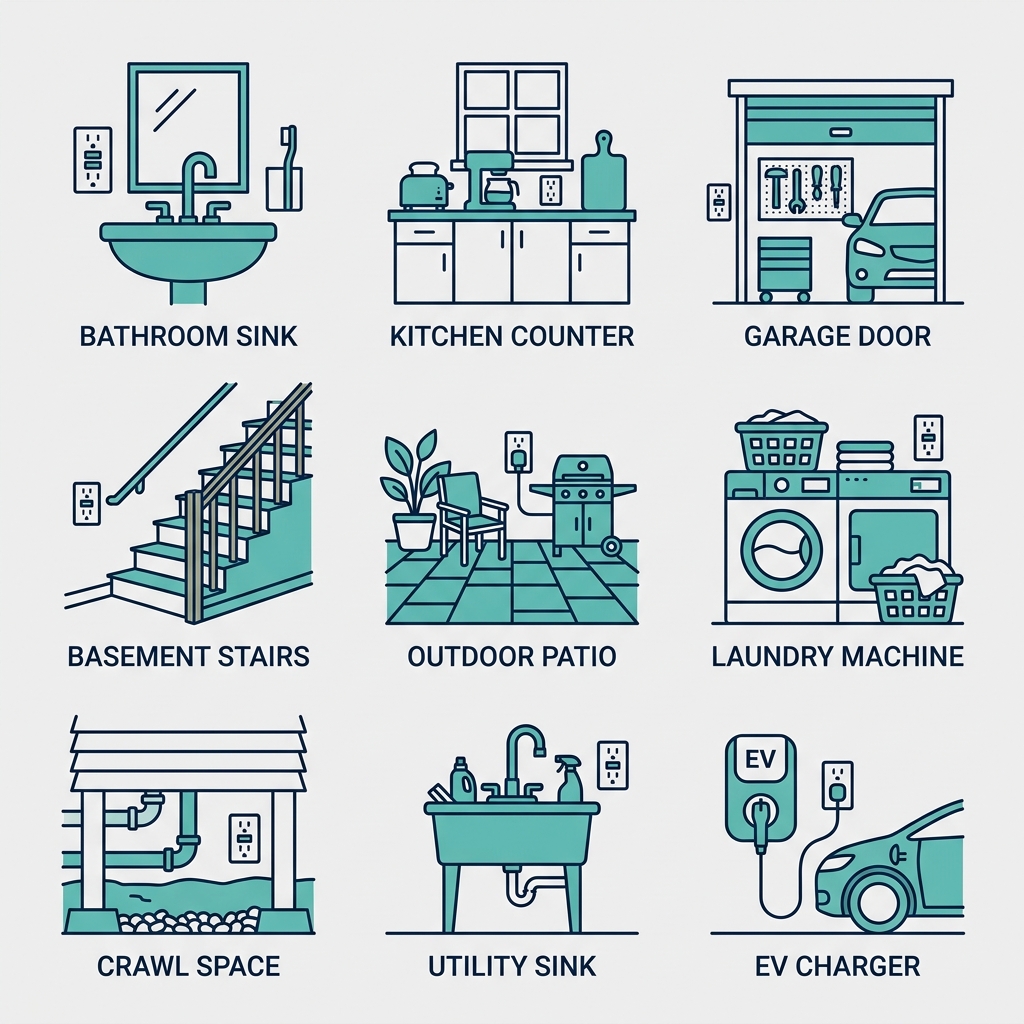
GFCI safety icon set for mandatory home locations
If you’re unsure whether your home meets current GFCI outlet installation requirements, our Licensed Local Electricians You Can Trust are ready to help. We provide dependable, affordable high-quality electrical services and a 100% satisfaction guarantee. Contact us to schedule a professional inspection and ensure your home is fully protected.
GFCI Outlet Versus GFCI Breaker Protection
Choosing the right ground fault protection is essential for modern home safety, especially when reviewing gfci outlet installation requirements for new construction or renovations. While both GFCI outlets and GFCI breakers provide critical shock prevention, they operate at different points in your electrical system. Understanding these differences helps you select the most practical and code-compliant solution for your specific needs.
A GFCI outlet protects only the downstream outlets on the same branch circuit, interrupting power at the receptacle when it detects a ground fault. In contrast, a GFCI breaker safeguards the entire circuit, including all wiring and connected outlets, by tripping at the main panel. The following table highlights the key distinctions between these two forms of protection.
GFCI Outlet vs GFCI Breaker: Key Differences
| Aspect | GFCI Outlet | GFCI Breaker |
|---|---|---|
| Location of Protection | Protects only the downstream outlets on the same circuit. | Protects the entire circuit, including wiring and all outlets. |
| Ease of Reset | Resets at the outlet location; easy access required. | Resets at the breaker panel; accessible but may require going to basement/garage. |
| Cost per Protected Point | Lower if only a few outlets need protection. | Higher initial cost, but economical for whole-circuit coverage. |
Resetting a tripped device also differs between the two options. A GFCI outlet features a reset button directly on the receptacle, making it convenient when the outlet is in an accessible location such as a kitchen backsplash. A GFCI breaker, however, requires you to go to the electrical panel, which may be in a basement, garage, or utility closet. This can be slightly less convenient but also keeps the reset mechanism centralized for all outlets on that circuit.
Cost per protected point is another important factor. GFCI outlets are typically more budget-friendly when you only need to protect one or two receptacle locations. However, when protecting an entire circuit, such as a new dedicated line for an EV charger, a GFCI breaker becomes more economical. For homeowners planning an EV charger installation, we recommend reviewing the level 2 charger installation cost to budget for the complete project, which may include a required panel upgrade if your existing system lacks sufficient capacity. According to our internal FAQ, many older homes with 100-amp service need a panel upgrade to safely support a new 40, 50, or 60-amp circuit.
Code compliance is another critical consideration. NEC 2026 requirements mandate GFCI protection in specific areas of your home, including kitchens, bathrooms, garages, outdoor circuits, and crawlspaces. Both GFCI outlets and GFCI breakers satisfy these code requirements when installed correctly. For new circuits dedicated to major appliances or EV chargers, local codes often require GFCI breaker protection at the panel. Safety is our #1 priority, and our licensed electricians ensure every installation meets or exceeds current electrical codes and industry standards.
Now that you understand the differences between GFCI outlets and breakers, let’s look at the specific installation requirements for each option. Whether you need a single outlet protected or whole-circuit coverage, our team of Licensed Local Electricians You Can Trust is ready to help you select and install the right solution for your home.
Our detailed guide to GFCI installation walks through the testing process we perform on every outlet. When you need a new circuit for a Level 2 charger, our FAQ resources explain when a panel upgrade is necessary to meet modern electrical demands.
Troubleshooting Outdoor GFCI Outlet Issues
Understanding gfci outlet installation requirements helps you determine whether a tripping outlet needs a simple reset or a professional replacement. Outdoor GFCI outlets are designed to cut power during a ground fault, but moisture from rain, sprinklers, or condensation is the most common cause of nuisance tripping. Even a correctly installed GFCI can malfunction, so we’ve outlined a systematic approach to restore safe operation.
- Press the Reset Button
Firmly press the RESET button. If you hear a click and the button stays in, the GFCI is functioning and the outlet should now deliver power. - Press Test Then Reset
If the RESET button does not engage, press the TEST button first, then try RESET again. This sequence can clear a minor ground fault that is preventing the reset. - Check the Breaker Panel
Inspect your main electrical panel for a tripped circuit breaker. If the breaker feeding the outdoor circuit is in the middle or OFF position, reset it fully to the ON position, then return to the outlet and attempt the RESET button once more. - Test with a GFCI Tester
Use a plug-in GFCI tester (available at any hardware store) to verify the outlet’s wiring is correct and that the GFCI trips when it should. This confirms proper grounding and that the internal protection mechanism is working.
Repeated tripping after you’ve reset the outlet may indicate a ground fault in the connected equipment—such as lights, timers, or extension cords—or deteriorating insulation. Unplug everything and test the outlet again; if it holds, the problem is with the device, not the outlet itself.
If the outlet still fails to reset after confirming power at the breaker, or if you notice any of the following warning signs, call a licensed electrician:
- The outlet is cracked, hot, or over 10 years old.
- You hear buzzing or smell burning near the outlet.
- The GFCI will not reset after following all steps.
Our Licensed Local Electricians You Can Trust in Tampa can diagnose and replace the outlet quickly. We provide upfront estimates with no hidden fees, and our fully trained technicians can arrive within 60–90 minutes for same-day service.
Safety is our #1 priority. Never bypass GFCI protection—it violates code and creates a shock hazard. For comprehensive safety tips, explore these electrical safety resources from the Electrical Safety Foundation International. Proper requirements for GFCI outlet installation ensure reliable performance, so if your outlet fails to reset, call a professional.
The Cost of Professional GFCI Outlet Installation
Because GFCI outlet installation requirements mandate these specialized devices in moisture-prone areas of your home, planning for their installation is a practical step in any electrical upgrade. Understanding the factors that shape the cost helps you budget wisely and recognize why professional installation by licensed local electricians you can trust is a sound investment. We provide transparent, upfront pricing that reflects the real scope of work, ensuring you know what to expect from the start.
The price of installing a GFCI outlet generally depends on several key variables. The total number of outlets you need and whether we are performing a simple replacement or running new wiring are primary cost drivers. For instance, placing a new circuit for outlets in a bathroom or kitchen where none existed before will involve more labor and materials than swapping an old standard outlet for a GFCI model. The accessibility of the installation site and the condition of your current wiring also play a role, as older homes may require more preparatory work to meet modern safety standards.
Another significant factor is whether your electrical panel can support the new load. While GFCI outlets themselves are low-profile safety devices, adding multiple new circuits—or upgrading to support heavier appliances—could require an electric panel upgrade or new circuit installation. This ensures your system operates safely and meets all gfci outlet code requirements. In our experience, homes across our service areas, from Santa Monica to Orange County, can have unique infrastructure that shapes the final estimate. That’s why we offer free estimates, giving you a clear, line-item view of costs for labor, materials, and any necessary permits, reflecting our commitment to no hidden fees.
Beyond the immediate expense, professional installation is crucial for code compliance. Electrical codes specify where GFCI outlets are required, including bathrooms, kitchens, garages, and all outdoor locations. Our fully trained technicians ensure every installation meets or exceeds these standards, preventing the risks of non-compliance and faulty wiring. We stand behind our work with a 100% satisfaction guarantee, meaning that your safety and peace of mind are protected long after the job is done. Safety is our #1 priority, and this focus on precision eliminates the potential hazards of an incorrect DIY approach.
Once you understand the investment in these critical safety devices, it’s clear that quality installation offers long-term reliability. With lightning-fast response times (often within 60-90 minutes) and a dedication to superior workmanship, we make the process straightforward. Contact us for a free, no-obligation quote to receive an accurate price for your specific project. Results may vary based on individual circumstances and building conditions, but our commitment to your safety never wavers.
Building a Safer Home with GFCI Protection
At High Voltage Electrical, safety is our #1 priority—and proper GFCI protection is one of the most effective ways to safeguard your home from electrical shock. Ground fault circuit interrupter (GFCI) outlets are designed to detect dangerous ground faults and cut power within milliseconds, significantly reducing the risk of electrocution. According to the Electrical Safety Foundation International (ESFI), these devices have prevented countless injuries and deaths by interrupting electrical faults before they can cause harm.
Meeting gfci outlet installation requirements means installing GFCI outlets in bathrooms, kitchens, garages, basements, outdoor areas, and any location within 6 feet of a sink or water source. The National Electrical Code (NEC) mandates these locations to protect the areas where water and electricity most often meet. Proper installation demands correct wiring, secure grounding, and precise placement, which our licensed electricians handle with full code compliance.
For reliable, code-compliant protection, we offer GFI Electrical Outlets Installation with fully trained technicians who follow a safety-first approach. Every installation meets or exceeds industry standards, giving you confidence that your home is protected. Beyond GFCI protection, homeowners should also consider whole-home surge protection and panel upgrades. Contact our licensed electricians to discuss your GFCI needs.