
Table of Contents
- Aluminum Wire Pigtailing: A Comprehensive Guide to Safe Aluminum Wiring Remediation
- Why Aluminum Wiring Poses Risks in Older Homes
- Comparing Aluminum Wire Pigtailing vs. Full Rewiring: Costs and Benefits
- How to Plan and Budget for Cost-Effective Aluminum Wire Pigtailing
- AlumiConn vs. COPALUM Connectors: Choosing the Right Method
- Common Questions About Aluminum Wiring Remediation and Insurance
- Evaluating Your Options for Safe Aluminum Wiring Remediation
Aluminum Wire Pigtailing: A Comprehensive Guide to Safe Aluminum Wiring Remediation
Aluminum wire pigtailing is a proven remediation technique that safely joins copper pigtails to existing aluminum circuit wires using specialized connectors like AlumiConn or Copalum. This code-compliant process mitigates the fire risk associated with aging aluminum branch circuits installed in millions of homes across the country.
Between the mid-1960s and the late 1970s, aluminum wiring was commonly used in residential construction as a cost-effective alternative to copper. However, aluminum conductors expand and contract with heat cycling, eventually loosening connections at outlets and switches. This can lead to high-resistance points that generate excessive heat—a significant fire hazard. The Electrical Safety Foundation International (ESFI) warns that aging and improperly maintained wiring (including aluminum circuits) is a leading contributor to residential electrical fires, underscoring the need for professional assessment.
For homeowners looking to address these risks, pigtailing provides a safe and cost-effective alternative to a complete rewire. In many cases, it eliminates the need for a disruptive and expensive whole-house rewiring project. At High Voltage Electrical, we deliver professional aluminum wiring remediation with transparent pricing and NO HIDDEN FEES. With over two decades of experience, our licensed electricians use only approved connectors and follow all applicable safety codes to restore dependable, long-term protection. In the section that follows, we will explore Why Aluminum Wiring Poses Risks in Older Homes, detailing the specific hazards that make remediation essential.
Why Aluminum Wiring Poses Risks in Older Homes
Before we explore pigtailing, it is crucial to understand why aluminum wiring in homes built between 1965 and 1973 poses serious electrical hazards. Single-strand aluminum was used extensively.
Aluminum expands and contracts far more than copper under electrical load. Over years of heating and cooling, this movement—known as thermal creep—loosens the connections at outlets, switches, and splices. Once a connection becomes loose enough, a dangerous arc can ignite nearby materials. At the same time, aluminum oxidizes almost instantly when exposed to air, forming a hard, non-conductive alumina layer. This oxide raises resistance at every splice, generating additional heat that accelerates the cycle of connection failure.
The National Fire Protection Association (NFPA) confirms that aluminum branch-wiring is implicated in a disproportionately high number of residential electrical fires compared to copper systems. These fires often start unseen inside walls. The combined effects of thermal creep, oxidation, and poor connection stability make older aluminum circuits especially dangerous—even when they appear to be functioning normally.
Beyond fire risk, aluminum wiring can jeopardize a home’s insurability. Many insurance companies raise premiums or deny coverage outright unless the system is professionally remediated, and a fire traced to known aluminum wiring may even void an insurance payout. These pressures lead many homeowners to consider the aluminum wiring replacement cost when planning long-term safety upgrades—but ignoring the problem can be far costlier.
Homeowners should watch for signs your home needs rewiring such as flickering lights, warm outlet covers, discolored switches, or faint burning odors, drawn from our own field experience at High Voltage Electrical. The table below summarizes the risk differences between aluminum and copper wiring.
| Risk Factor | Aluminum Wiring | Copper Wiring |
|---|---|---|
| Fire Hazard | High – prone to arcing and overheating | Low – stable under normal loads |
| Oxidation/Corrosion | Severe – non-conductive oxide raises resistance | Minimal – oxide remains conductive |
| Connection Stability | Poor – thermal expansion loosens connections | Excellent – stays tight over time |
| Insurance Implications | Problematic – may require remediation before insuring | Standard – no wiring surcharges |
| Compatibility with Modern Fixtures | Limited – special connectors needed for most devices | Universal – works with all standard fixtures |
Given these dangers, homeowners have two primary paths: pigtailing or full rewiring. In the next section, we compare the costs and benefits of each approach. If you notice any warning signs, we strongly recommend a professional inspection—our licensed electricians at High Voltage Electrical provide thorough assessments backed by our 100% satisfaction guarantee.
Comparing Aluminum Wire Pigtailing vs. Full Rewiring: Costs and Benefits
After understanding why aluminum wiring poses real safety risks in older homes, the next logical step is evaluating your remediation options from a value standpoint.
Evaluating the Cost Differences: Pigtailing vs. Full Rewire
Choosing between pigtailing and a complete rewire comes down to three practical factors: budget, time, and the level of disruption your household can tolerate.
Based on our experience across hundreds of projects, pigtailing is the more cost-effective path for most homes. The total cost of a professional pigtailing job—using UL-listed AlumiConn or COPALUM connectors on every affected circuit—typically runs several thousand dollars less than a full copper rewire.
Cost Comparison: Pigtailing vs. Full Rewire
| Cost Factor | Pigtailing (AlumiConn/COPALUM) | Full Rewire |
|---|---|---|
| Average Total Cost | $2,000 – $4,000 (varies by home size and connector type) | $8,000 – $15,000+ |
| Timeframe | 2–3 days | 1–2 weeks |
| Disruption Level | Minimal – targeted work at each outlet, switch, and fixture point | Significant – walls may need to be opened, baseboards removed, furniture relocated |
| Permit Requirements | Usually required – $100–$300 typical fee range | Required – $200–$500+ depending on scope and jurisdiction |
| Compliance | Code-compliant when installed with UL-listed connectors (AlumiConn or COPALUM) and properly torqued | Full compliance with modern NEC standards for new copper circuits |
| Impact on Homeowners Insurance | May satisfy insurer requirements for aluminum wiring remediation, often improving insurability | Often mandatory for continued coverage; many insurers demand a complete rewire when aluminum circuits are present |
Pigtailing can be completed in days rather than weeks, keeping your family’s daily life largely undisturbed.
Per-Outlet Pricing Breakdown for Aluminum Wire Pigtailing
Understanding what you’re paying for at each connection point helps you see the long-term value.
- AlumiConn connectors: The connector itself costs roughly $3–$5 per unit. Combined with our skilled labor to torque each connection to manufacturer specifications, a single outlet typically lands between $35 and $50, materials and labor included.
- COPALUM connectors: This older, patented process requires a specialized crimping tool and factory-trained installers. Materials and labor are higher—most outlets run $45 to $65—though the final result is equally code-compliant.
A modest home with 40–60 affected connection points would see a total pigtailing investment comfortably inside the $2,000–$4,000 window. The connector you choose influences the final price, but both options deliver a safe, code-verified repair for a fraction of a full rewire.
Understanding Permit Requirements for Electrical Remediation
Nearly every municipality in our service area requires an electrical permit when remedial work is performed on aluminum branch circuits. Safety is our #1 priority, so we treat the permit step as non-negotiable—it’s the backbone of a code-compliant job.
Permit fees typically range from $50 to $300, depending on your local building department’s fee schedule. That permit gives you documented proof that the work was inspected and approved.
For homeowners specifically concerned about homeowners insurance aluminum wiring requirements, pulling the proper permit and passing inspection can be exactly what your insurer needs to see. We always recommend consulting electrical safety resources to understand the current best practices, and our team handles the permit application and inspections from start to finish.
Ultimately, whether you choose pigtailing or a complete copper rewire, the decision rests on your budget, your tolerance for disruption, and the scope of work your property requires.
How to Plan and Budget for Cost-Effective Aluminum Wire Pigtailing
Having weighed the costs and benefits of pigtailing versus full rewiring, the next step is planning and budgeting for your project. A methodical approach ensures your home’s electrical system receives the right remediation at a fair price, whether you’re addressing a few suspect circuits or an entire property. We’ll walk you through the process our team uses to deliver transparent, no-hidden-fee solutions.
Step-by-Step Planning for a Safe Pigtailing Project
Proper planning transforms a complex wiring remediation into a manageable project. We recommend following a structured sequence to protect your property and investment.
- Inventory all affected components: Walk through your property and identify every outlet, switch, and junction box that contains aluminum wiring. Note their locations and the circuits they serve.
- Prioritize circuits by risk level: High-load circuits demand attention first. Kitchen appliances, HVAC systems, laundry equipment, and bathroom outlets experience the most thermal stress and pose the greatest fire hazard.
- Obtain multiple professional assessments: Secure quotes from at least three licensed electrical contractors. This comparison helps you evaluate scope, methodology, and pricing transparency.
- Verify credentials thoroughly: Confirm that any electrician you consider holds active licensing, carries adequate insurance, and maintains compliance with NFPA safety standards for all pigtailing connections. Our technicians adhere to these protocols on every job.
Budgeting and Financing for Aluminum Wiring Remediation
Understanding potential costs allows you to plan confidently. The following table outlines typical ranges based on home size, reflecting the value pigtailing offers compared to full rewiring.
| Home Size (sq ft) | Estimated Outlets/Switches | Pigtailing Cost Range | Full Rewire Cost Range |
|---|---|---|---|
| 1,000 sq ft | 12-15 | $500–$1,000 | $3,000–$5,000 |
| 2,000 sq ft | 20-25 | $1,000–$2,000 | $5,000–$10,000 |
| 3,000 sq ft | 30-35 | $1,500–$3,000 | $8,000–$15,000 |
These figures illustrate why pigtailing remains the cost-effective choice for most homeowners. Our estimates represent the typical range, with final pricing confirmed during the on-site evaluation.
Financing options make remediation accessible. Home equity loans and personal loans from credit unions offer structured repayment. Some contractors provide payment plans, though terms vary. We provide upfront, itemized quotes covering material costs, labor hours, permit fees, and a clear timeline. This commitment to transparent pricing eliminates surprises and lets you budget accurately.
Navigating Homeowners Insurance Coverage and Discounts
Aluminum wiring directly influences your insurance standing. Some carriers may drop coverage if unaddressed aluminum wiring is discovered, while others offer premium reductions once verified remediation is complete. Many insurers provide premium discounts ranging from 5 to 10 percent after professional pigtailing is documented.
To satisfy an insurer’s requirements, you’ll need three key documents: a permit from your local building department, an itemized invoice from the licensed electrician detailing the work performed, and a certificate of completion confirming that all connections follow industry standards. We provide this documentation for every job, supporting your efforts to secure the best possible rate.
Our lightning-fast response times mean you can address wiring concerns before they become insurance obstacles. Once you have a solid plan and budget, the final key decision is choosing the right connector method—AlumiConn vs. COPALUM—which we cover in the next section.
AlumiConn vs. COPALUM Connectors: Choosing the Right Method
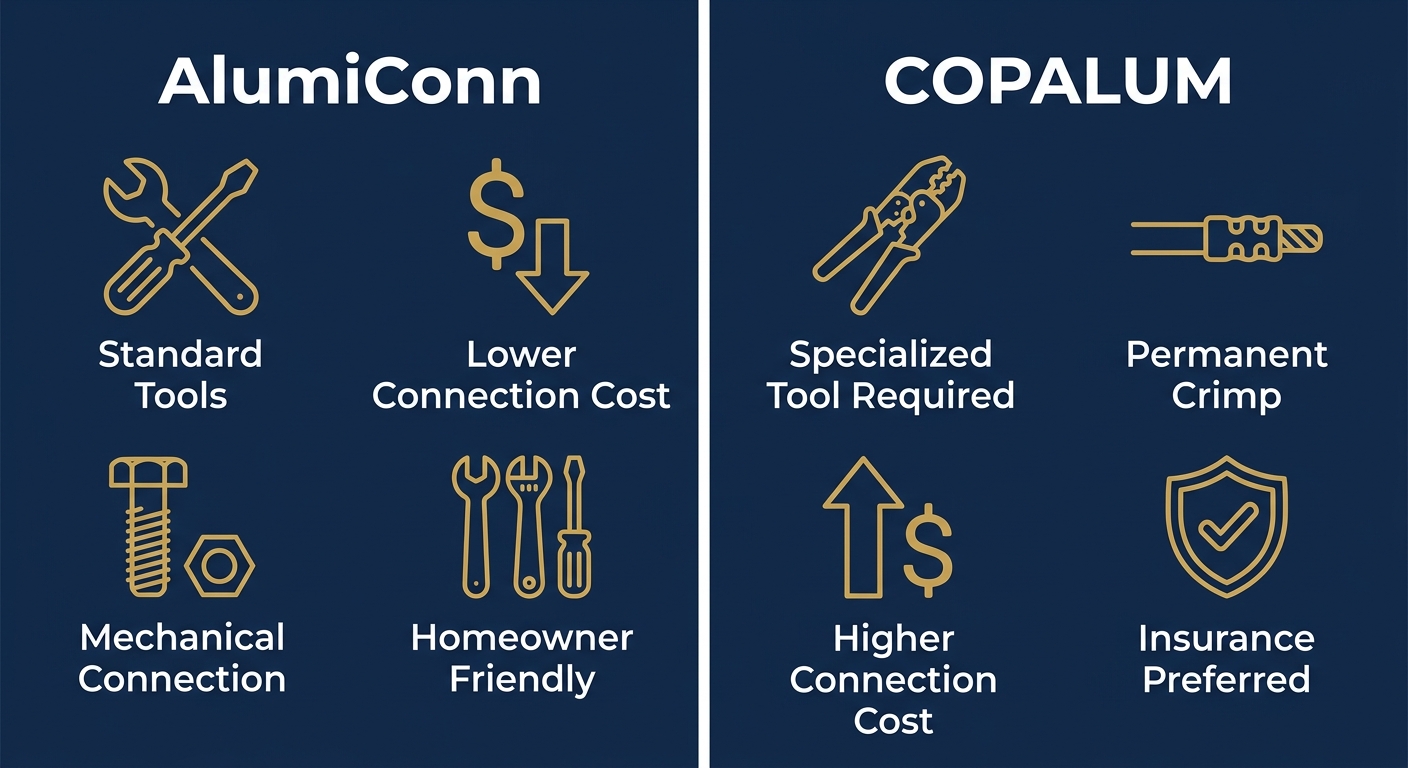
Now that you’ve planned and budgeted for cost-effective aluminum wire remediation, the next step involves selecting the right connector system. The two primary pigtailing connectors available today—AlumiConn and COPALUM—offer distinct approaches, and understanding their differences helps you make the best choice for your home.
| Feature | AlumiConn | COPALUM |
|---|---|---|
| Installation Complexity | Moderate; uses standard tools | High; requires special crimping tool |
| Cost per Connection | Lower cost per connection | Higher cost per connection plus tool investment |
| Required Tools | Screwdriver (common tools) | Specialized crimping tool (rental/purchase) |
| Insurance Approval | Often accepted; verify with provider | Widely recognized as permanent repair |
| Long-term Reliability | Reliable when installed by fully trained technicians | Highly reliable with consistent crimp |
AlumiConn connectors are designed for straightforward installation using standard screwdrivers, making them an economical option for smaller projects. In contrast, COPALUM crimping requires a specialized tool that adds upfront cost, but the per-connection reliability and insurer recognition often justify the investment for whole-house remediation. We always assign fully trained technicians to every job, ensuring that whichever connector is used, it is installed to code and performs reliably over time.
Insurance acceptance is a critical consideration. COPALUM crimps are widely recognized by insurers as a permanent repair method, while AlumiConn connectors are also accepted by many providers—though we encourage verifying with your specific carrier. Both connector types have been tested against International Electrotechnical Commission (IEC) standards, confirming their long-term durability when correctly applied. For comprehensive installation standards, we recommend exploring NECA resources on aluminum wiring repair.
We can help you assess your home and implement the approach that meets all criteria safely and cost-effectively. Once you understand the differences, common questions about insurance coverage and safety often arise—we’ll address those next.
Common Questions About Aluminum Wiring Remediation and Insurance
Now that we’ve compared AlumiConn and COPALUM connectors, many homeowners ask about how remediation affects insurance.
- Does aluminum wiring affect my home insurance? Many insurers view aluminum wiring as a fire risk; it can lead to higher premiums or coverage denial.
- Will professional remediation lower my insurance premium? Remediation using approved connectors satisfies insurer requirements and may reduce premiums, though results vary by carrier.
- What documentation does my insurer need? Keep your invoice, inspection report, and certificate of compliance after our work; provide these to your insurer for verification.
High Voltage Electrical offers pricing for aluminum wire replacement that meets safety standards recognized by insurers. Our team ensures you receive documentation to support your insurance policy.
Once you understand the insurance implications, it’s time to evaluate your options for safe aluminum wiring remediation.
Evaluating Your Options for Safe Aluminum Wiring Remediation
With those important insurance and safety questions in mind, the next step is choosing the right professional for aluminum wiring remediation.
Ensure they hold a state license, full insurance, transparent pricing, and a satisfaction guarantee. High Voltage Electrical meets both criteria per our service page and brings nearly two decades of experience with a 60–90 minute response guarantee. We deliver dependable, affordable high-quality electrical services, including aluminum wire pigtailing.
Contact us for dependable electrical services in Aliso Viejo and let our licensed technicians handle your aluminum wiring retrofit.
Get Your Free Remediation Estimate
Now that you’ve compared the costs and benefits of aluminum wire pigtailing versus full replacement, it’s time to take action for your home’s safety. High Voltage Electrical offers a 100% satisfaction guarantee and same-day service on many projects. Our licensed electricians provide transparent pricing and a 60–90 minute response guarantee. Call (855) 501-7800 today for a free estimate and let us handle your remediation. Protect your investment and enjoy peace of mind with professional aluminum wiring correction.
Get Your Free Remediation Estimate