
Table of Contents
- Understanding AFCI Breaker Installation Requirements
- AFCI Protection: What Homeowners Need to Know
- NEC 210.12 Requirements and AFCI Breaker Functionality
- Installing AFCI Breakers: Process and Cost Factors
- Dual Function AFCI/GFCI Breakers and Advanced Safety Solutions
- Common Questions About AFCI Breaker Installation
- Prioritize Electrical Safety with Professional AFCI Installation
Understanding AFCI Breaker Installation Requirements
Understanding afci breaker installation requirements begins with knowing what an arc-fault circuit interrupter actually does. An AFCI is a specialized circuit breaker designed to detect dangerous electrical arcing, essentially, sparks within your wiring that can generate intense heat and ignite a house fire, and cut off power before a blaze can start.
According to the National Fire Protection Association, the NFPA 70 (the National Electrical Code) requires AFCI protection in living areas, bedrooms, and similar spaces within dwelling units. The NFPA creates codes and standards through a consensus of experts to provide safety standards to help reduce fire hazards. These standards are often adopted by jurisdictions, so homes must comply with them to pass electrical inspections and keep insurance coverage intact. We always position these breakers directly on the electrical service conductors inside your home’s service panel, ensuring code-compliant protection at the source. That placement also aids inspectors and compliance.
Our licensed electricians provide this specialized work with transparent, value-focused pricing and no hidden fees, so you understand exactly what the installation involves. Homeowners often need this information when considering the safety and protection of their families and home. Knowing these code requirements helps homeowners make informed electrical-safety decisions, whether they’re upgrading an outdated panel or wiring a new room addition.
AFCI Protection: What Homeowners Need to Know
While it is important to understand the correct installation of AFCI breakers, homeowners also want to know the function of arc fault protection and the reasoning behind it.
An arc fault circuit interrupter (AFCI) is a type of safety device that continuously monitors the electrical circuits in your house for dangerous arc faults. Arc faults occur when the electrical current “jumps” or “hops” from one conductor to another. This creates a very high temperature (10,000°F) which can ignite nearby materials such as the wood or insulation in your walls. The AFCI detects the pattern of an arc fault and turns off the circuit to stop the potential fire.
According to the National Fire Protection Association (NFPA), electrical failures and malfunctions are a leading contributor to home structure fires nationwide. The Electrical Safety Foundation International (ESFI) reinforces that many of these incidents stem from arc faults that a standard circuit breaker simply cannot detect. The NFPA 70, or National Electrical Code, addresses this risk through NEC 210.12 arc fault protection requirements that mandate AFCI coverage in many areas of a modern home.
There are a number of everyday conditions that can create the arc faults that AFCI breakers are designed to catch:
- Damaged or frayed electrical cords on lamps, appliances, or extension cables
- Loose wire connections at outlets, switches, or inside junction boxes
- Corroded terminals on older wiring systems, especially in humid environments
- Worn, pinched, or cracked insulation caused by age, staples, or over-driven nails
- Internal wiring damage inside walls from remodeling, pests, or vibration
The AFCI responds to the unique electrical signature of that arc and offers a level of protection that complements traditional overload and short-circuit safeguards.
AFCI protection is now common in bedrooms, living rooms, family rooms, and dining rooms. It is also common in other general-use spaces where concealed wiring and combustible furnishings are present.
Homeowners sometimes worry when an AFCI breaker trips, but that brief outage is a sign the system is working as intended. You can safely reset the breaker once, but if it trips again, the underlying arc-fault condition still exists somewhere on that circuit. That is the moment to call a licensed electrician who can trace the fault, repair the damaged wiring or connection, and restore reliable protection.
If you believe you have arc-faults in your home’s electrical system, we recommend you call a licensed electrician. Our team at High Voltage Electrical provides comprehensive electrical inspections and can take care of any repair work that is needed. We are so confident you will be happy with our work so we back every job we complete with our 100% satisfaction guarantee.
NEC 210.12 Requirements and AFCI Breaker Functionality
Beyond the safety case, AFCI protection is also a formal requirement of the National Electrical Code. According to NFPA 70, NEC 210.12(A) mandates arc-fault circuit interrupter protection for all 120-volt, single-phase, 15- and 20-ampere branch circuits that supply outlets in dwelling-unit kitchens, family rooms, dining rooms, living rooms, bedrooms, sunrooms, recreation rooms, hallways, closets, laundry areas, and similar rooms.
NEC 210.12: Arc-Fault Protection Standards
When AFCI requirements first appeared in the 1999 NEC, they only covered bedrooms. Over successive code cycles the list grew to include nearly every living space. While the NEC sets the national foundation, local jurisdictions in California and Texas sometimes adopt amendments, so local code takes precedence over the base text.
An AFCI breaker monitors the electrical waveform delivered to the circuit. It uses built-in electronics to recognize the unique signature of a dangerous arc fault — a series arc created by a loose terminal or a damaged cord, or a parallel arc resulting from nicked or deteriorated insulation. When the breaker’s algorithm detects a hazardous arc, it trips instantly, ignoring the harmless arcing that occurs during normal appliance operation.
At High Voltage Electrical, Safety is our #1 priority. The Electrical Safety Foundation International (ESFI) emphasizes that arc faults are a leading cause of home electrical fires, and properly installed AFCI protection significantly reduces that risk. We install only breakers that meet the latest NEC standards and any applicable local amendments.
Comparing AFCI and GFCI Breakers
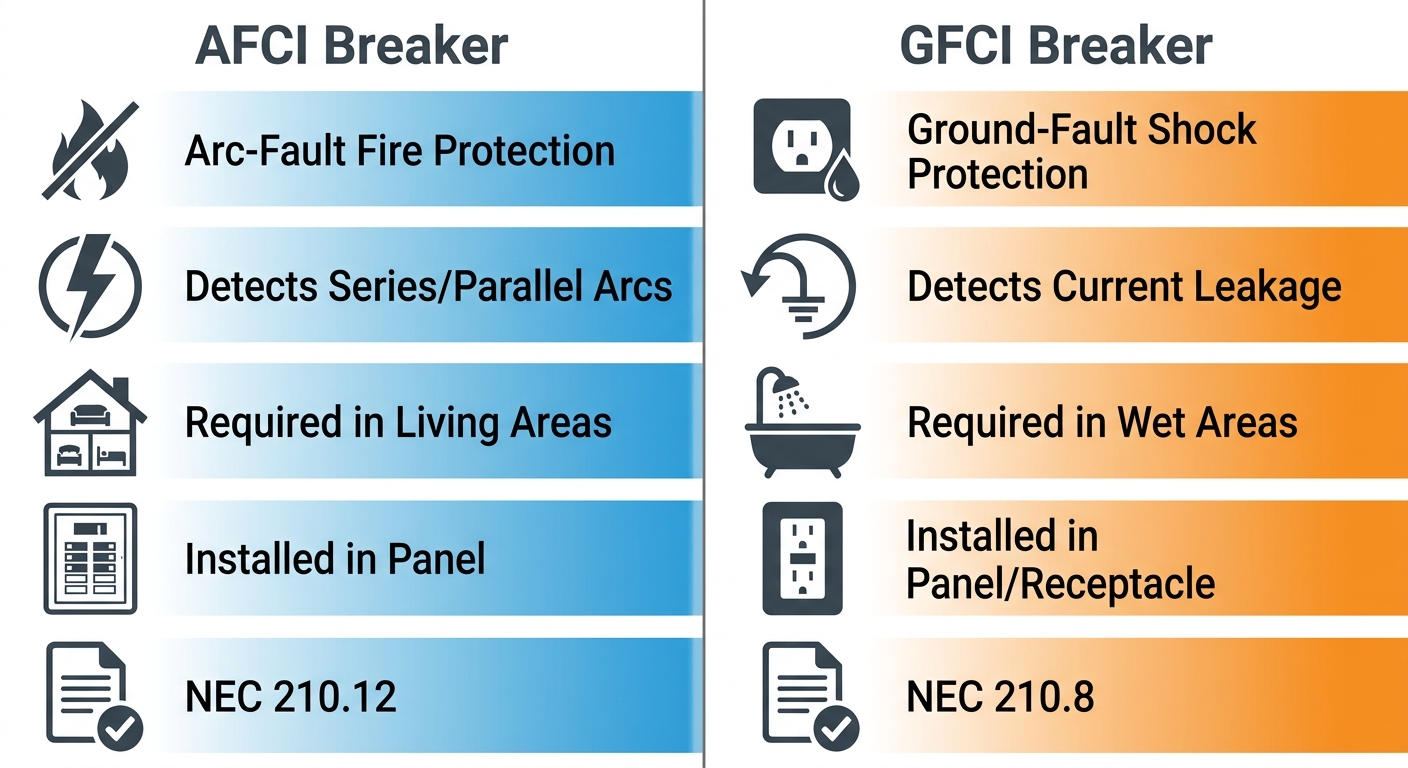
AFCI and GFCI breakers serve distinct but complementary purposes. An Arc-Fault Circuit Interrupter lowers the risk of electrical fires by detecting dangerous arcing, while a Ground-Fault Circuit Interrupter protects against electric shock by tripping on ground-fault leakage of 4–6 milliamps in roughly 1⁄40 of a second. Neither device is a substitute for the other; homes often need both.
The table below summarizes the key differences:
| Feature | AFCI Breaker | GFCI Breaker |
|---|---|---|
| Full name | Arc-Fault Circuit Interrupter | Ground-Fault Circuit Interrupter |
| Primary function | Prevents electrical fires | Prevents electric shock |
| What it detects | Series and parallel arc faults | Ground faults (4–6 mA leakage) |
| Where required | NEC 210.12 living areas (kitchens, family rooms, bedrooms, hallways, etc.) | NEC 210.8 wet and damp locations (bathrooms, kitchens, garages, outdoors) |
| Protection type | Fire protection | Shock protection |
| Common locations | Bedrooms, living rooms, hallways | Bathrooms, kitchens, garages, outdoors |
Because many circuits now fall under both mandates, dual function afci gfci breakers have become a practical solution. A combination-type AFCI breaker detects series and parallel arcs, while a dual-function breaker adds 5 mA ground-fault protection in the same unit — delivering comprehensive safety from a single slot in the panel. This approach is especially valuable in kitchens, where the NEC requires AFCI protection for all branch-circuit outlets and GFCI protection within six feet of a sink.
Tying AFCI protection directly to the panel also aligns naturally with panel-upgrade work, giving us an opportunity to modernize an entire circuit’s protection at once.
A clear understanding of the code requirements and how each breaker type functions lays the groundwork for the next logical step — putting that knowledge into action by installing an AFCI breaker and managing the practical factors that shape the project.
Installing AFCI Breakers: Process and Cost Factors
As the NEC requires more areas of the home to have AFCI protection, the process of understanding how to install AFCI breakers becomes simpler. In this section, our licensed electricians outline the step-by-step process of how they swap a standard breaker for an AFCI breaker. It also explains what factors affect the cost of installing AFCI protection.
Step-by-Step AFCI Breaker Installation Process
With AFCI breaker installs, we adhere to a clear, safety-first procedure.
- Turn off the main breaker and verify the panel is dead – Power to the entire panel must be switched off at the main breaker. We use a non-contact voltage tester on every wire and terminal to confirm there is no live current before proceeding.
- Identify the circuit and label the wire – The branch circuit that will receive AFCI protection is traced at the panel, and the hot wire is clearly marked.
- Remove the panel cover and the existing standard breaker – Once we are certain the panel is de-energized, the deadfront cover is removed and the standard breaker is carefully unclipped from the bus bar. The hot wire is then disconnected from the old breaker.
- Connect the AFCI breaker’s neutral pigtail to the neutral bus bar – Unlike a standard breaker, an AFCI breaker includes a white pigtail wire that must be landed on the neutral bus. This connection allows the breaker to sense dangerous arc signatures and trip before a fire can start.
- Attach the hot wire to the new breaker and seat it firmly – The circuit’s hot conductor is inserted into the AFCI breaker’s terminal and torqued to the manufacturer’s specification.
- Restore power, test, and reset – The main breaker is turned back on, and we press the TEST button on each new AFCI breaker. A prompt trip confirms the arc-detection circuitry is functioning correctly. After resetting the breaker, we verify normal power flow to the circuit.
Working inside an electrical panel without proper training can lead to serious injury or fire. The Electrical Safety Foundation International (ESFI) emphasizes that arc-fault circuit interrupters significantly reduce electrical fire risks when installed correctly, making professional installation a wise choice.
What Does AFCI Installation Cost?
The cost to add AFCI protection is a long-term safety investment. Although there are a number of factors that influence the overall cost, understanding these factors can help the consumer determine if the cost is reasonable.
| Item | Content |
|---|---|
| AFCI Breaker Unit | The breaker itself carries a premium over a standard breaker due to its advanced arc-detection circuitry. Price varies by brand, amperage, and whether it is a combination-type AFCI. |
| Labor | Professional installation time depends on panel accessibility and the number of breakers being replaced. |
| Panel Condition / Upgrades | Frequent tripping can signal an overloaded circuit or an aging panel that needs an upgrade. If your panel lacks spare capacity or contains outdated components, additional work may be required, which can raise the overall project cost. |
| Permits and Inspection | Local building codes often require permits for panel work. We handle the permitting process to keep your installation compliant. |
We have same day service available, lightning-fast response times, and transparent pricing. We offer a free site assessment and will give you a precise, no-surprise quote. For even broader protection, many homeowners combine AFCI and GFCI protection in a single breaker — an option we will discuss next.
Dual Function AFCI/GFCI Breakers and Advanced Safety Solutions
When completing an electrical upgrade, the breaker selection is just as important as the breaker installation. An AFCI/GFCI breaker is a compact, single-pole breaker, that integrates both ground-fault and arc-fault circuit protection. In comparison, an AFCI breaker only detects series and parallel arcing faults. A GFCI breaker only detects ground faults. In scenarios where both ground faults and arc faults are a concern, a dual-function breaker is the better solution. This is the case in areas such as Laundry rooms, Bathrooms, Kitchens, etc.
According to the National Fire Protection Association (NFPA), which publishes the National Electrical Code (NEC), AFCI protection is required for most living areas in dwelling units, while GFCI protection is mandated for wet locations including kitchens, bathrooms, garages, and outdoor outlets. Where a circuit serves spaces that fall under both requirements, a dual-function breaker can satisfy the full code obligation in a single device. Exact requirements can vary by local code cycle and jurisdiction, so only a qualified electrician should assess whether a dual-function breaker or separate AFCI and GFCI protection is appropriate for an existing panel. The NEC is revised on a three-year cycle to stay current with local amendments.
Beyond individual breakers, advanced safety solutions can further enhance a home’s electrical system. Whole-home surge protection shields all devices from voltage spikes, proper panel labeling helps with quick identification during maintenance, and testing breakers monthly using the TEST button ensures they remain functional. Installing a surge protector at the service entrance provides a first line of defense against external surges, while point-of-use devices protect sensitive electronics. Our fully trained technicians can evaluate the protective measures in place and recommend whether a panel modernization incorporating dual-function breakers is the practical path. Ultimately, choosing between dual-function, AFCI-only, and GFCI-only protection comes down to circuit-specific risks and code requirements, and upgrading alongside a panel replacement often provides the most efficient installation.
Common Questions About AFCI Breaker Installation
Does a tripping AFCI breaker mean I need a panel upgrade?
Not necessarily. Usually if you’re tripping breakers consistently in an older 100-amp panel or have Federal Pacific breakers or other known issues, that’s a good indication you may need an upgrade. An electrician can investigate this for you.
What are the installation requirements?
Make sure the breakers you purchase are for your panel’s brand and code for your area. We check for both during the job to ensure full code compliance.
Can I install an AFCI breaker myself?
Panel work is dangerous and must follow strict code. We recommend hiring a licensed electrician, licensed local electricians you can trust, to handle it safely.
Do you install AFCI breakers in Aliso Viejo?
Yes, our licensed electricians work in Aliso Viejo and surrounding Orange County.
Professional installation by our licensed team keeps your home safe.
Prioritize Electrical Safety with Professional AFCI Installation
The AFCI breaker installation requirements in the National Electrical Code (NFPA 70) exist to protect your family from arc faults — hidden fire hazards caused by damaged or aging wiring. Our licensed electricians handle AFCI installation across California and Texas, ensuring work that meets or exceeds codes and standards to help stop arc faults before they become a hazard. We provide dependable, affordable high-quality electrical services with transparent, no-hidden-fee pricing. Contact us to schedule your AFCI installation or electrical upgrades, we’re available 24/7 with 60–90 minute response times.
Get Expert AFCI Breaker Installation
You’ve now mastered the AFCI breaker installation requirements set by the National Electrical Code, and you understand how proper arc-fault protection significantly reduces the risk of the thousands of electrical fires that occur each year. Our licensed electricians install combination-type and dual-function AFCI/GFCI breakers that meet NEC 210.12 standards, giving your home layered protection for living areas, kitchens, and bedrooms. We provide transparent pricing with no hidden fees, and every job is backed by our 100% satisfaction guarantee. With same-day service and a 60–90 minute arrival window, we’re available 24/7 to handle your electrical panel needs. From Aliso Viejo to Pasadena and across Southern California and Texas, our team is the dependable choice for code-compliant AFCI protection. Schedule your installation today and take the next step toward a safer home.
Get Expert AFCI Breaker Installation