Table of Contents
- Understanding Knob and Tube Wiring in Older Homes
- How to Identify Knob and Tube Wiring in Your Home
- Dangers of Knob and Tube Wiring for Today’s Electrical Demands
- Replacing Knob and Tube Wiring Without Gutting Your Walls
- Electrical Panel Upgrades and Insurance for Homes with Knob and Tube
- Common Questions About Knob and Tube Wiring
- Ensuring a Safer Electrical Future for Your Home
Understanding Knob and Tube Wiring in Older Homes
Understanding knob and tube wiring identification is essential for owners of older homes. This electrical system was the standard from the late 1800s through the early 1940s, favored for its simplicity and low material cost. Builders used ceramic knobs to hold bare copper conductors along studs and rafters, while ceramic tubes insulated the wires where they passed through framing. Grounding was not part of the original design, a fundamental departure from modern electrical safety requirements.
These early installations were designed for basic lighting and a handful of outlets, nothing like the heavy appliances we use today. As electrical loads increased dramatically with the addition of refrigerators, televisions, and eventually computers, the shortcomings of ungrounded, two-wire systems became impossible to ignore. Knob and tube wiring lacks a grounding conductor, making it incompatible with three-pronged plugs and sensitive electronics. Over decades, insulation can crack, and improper modifications often create hidden fire hazards. Many insurers now require replacement before they will issue or renew a policy because the wiring no longer meets the National Electrical Code.
When we evaluate older properties, we frequently encounter knob and tube wiring that homeowners did not realize was present — often hidden behind newer panels or insulation. Knowing its history and limitations is the foundation for spotting it in your own attic or basement. This understanding prepares you to look for the telltale signs yourself.
How to Identify Knob and Tube Wiring in Your Home
Identifying knob and tube wiring is a critical first step for homeowners in older properties, particularly those constructed before the 1950s. This early electrical system was the standard for residential construction across North America from the 1880s through the 1940s, and while it is not inherently dangerous, its age and limitations can present significant safety concerns.
The following table compares the most common methods used to verify the presence of knob and tube wiring in a home.
| Identification Method | How It Works | Reliability | Typical Use Case |
|---|---|---|---|
| Visual Inspection | Homeowners look for white ceramic knobs and tubes in attics, basements, and floor joists, along with black or cloth-covered wires separated by four to six inches. | Medium — visible components confirm presence, but hidden sections in walls may be missed. | Initial homeowner assessment of accessible areas. |
| Professional Electrical Inspection | A licensed electrician conducts a thorough evaluation using specialized tools to trace circuits and assess wiring condition behind walls and fixtures. | High — trained professionals can identify K&T wiring even in inaccessible areas and evaluate associated safety risks. | Comprehensive home evaluation before purchase, renovation, or insurance requirement. |
| Age-Based Records Review | Homeowners or inspectors check building permits, previous inspection reports, and construction dates to determine if the home falls within the K&T era. | Low — confirms likelihood but not actual presence, as many homes have been partially or fully rewired. | Preliminary research for homes built between the 1880s and 1940s. |
During a visual check, homeowners should look for white porcelain knobs mounted along exposed joists and tubes passing through framing members. The conductors themselves are typically insulated with rubber and covered in cloth, appearing black or heavily darkened with age. Another distinctive feature is the wide separation between hot and neutral wires — four to six inches apart — a design element that allowed heat dissipation in free air.
According to InterNACHI, the porcelain components themselves have an almost unlimited lifespan, though the conductor insulation often degrades over decades.
Professional inspection offers the most reliable identification method, as licensed electricians can trace circuits through finished walls and ceilings.
Once identified, knob and tube wiring should be evaluated for safety modifications, insulation contact, and improper alterations, all of which significantly increase fire risk. Homeowners who suspect this wiring type in their property should contact a qualified electrical contractor for a thorough assessment and recommendations for bringing the system up to modern safety standards.
Dangers of Knob and Tube Wiring for Today’s Electrical Demands
Knob and tube (K&T) wiring was the standard electrical installation in American homes built between the 1880s and 1940s, and it remains present in many older properties. Deteriorating materials, missing modern safeguards, and the strain of high-wattage appliances turn these legacy circuits into a threat.
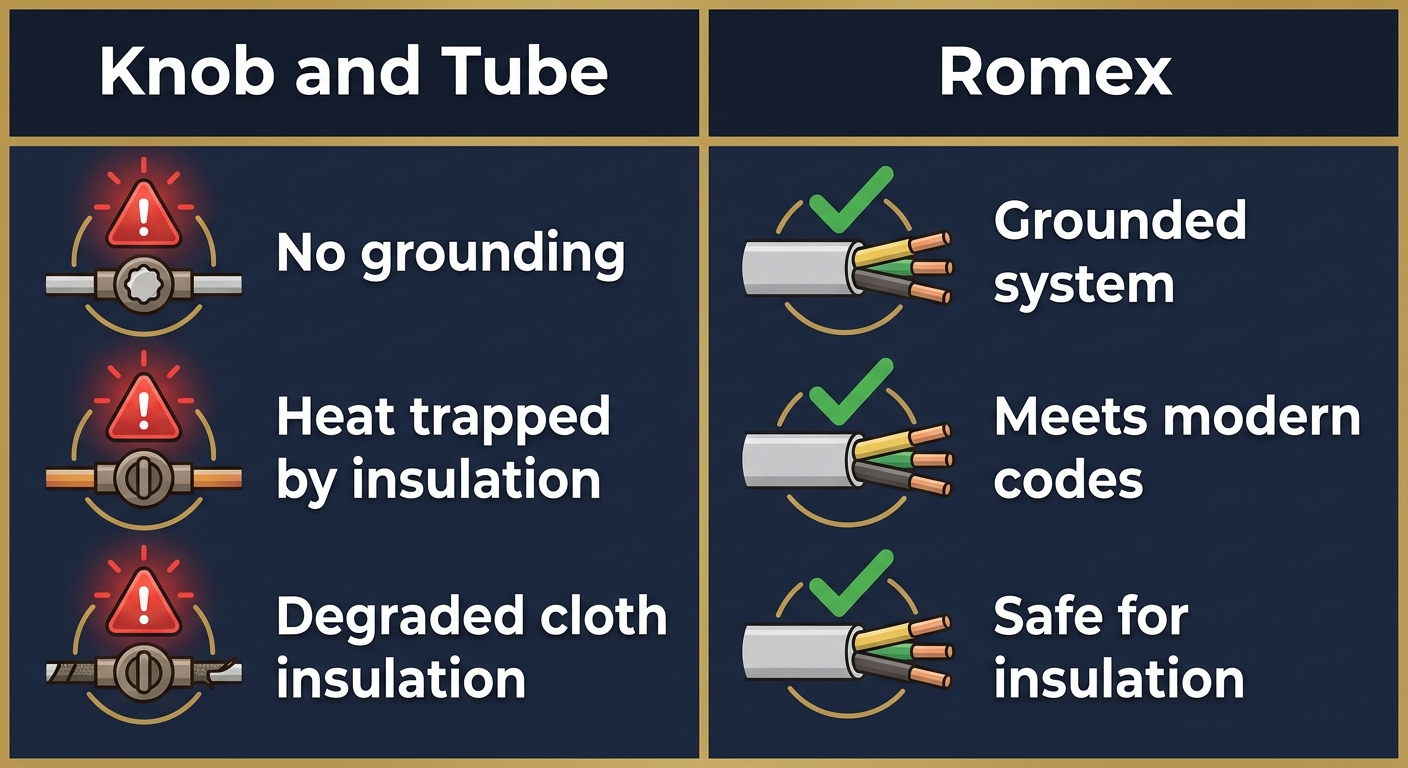
The following table contrasts the risk profiles of knob and tube wiring against modern Romex to illustrate why upgrading is a critical safety measure:
| Risk Factor | Knob and Tube Wiring | Modern Romex Wiring | Implication |
|---|---|---|---|
| Grounding | Lacks a ground wire, increasing the risk of electrical shock and appliance damage | Includes a dedicated grounding conductor that protects people and equipment | Dramatically reduces shock hazard and protects sensitive electronics |
| Fire Hazard from Insulation Contact | Heat becomes trapped when building insulation covers the wires, creating a fire ignition source | Designed and tested for safe contact with modern insulating materials per the National Electrical Code | Lowers the chance of an electrical fire inside walls and attics |
| Insurability | Many insurers refuse coverage without a certified electrician’s safety verification, effectively forcing a system upgrade | Accepted as standard by all homeowners insurance providers | Homeowners can secure and maintain coverage without costly riders or exclusions |
Why Knob and Tube Wiring Fails Modern Safety Standards
They lack a grounding conductor, which means outlets, appliances, and fixtures connected to the circuit have no direct path for fault current. The absence of ground not only increases shock risk but makes the wiring incompatible with three-pronged plugs and many surge protection devices. NPI and InterNACHI note that this missing safety feature is a primary reason insurers and inspectors treat K&T as obsolete for modern residential use.
Modern central air conditioning, electric ranges, entertainment systems, and EV chargers draw far more current than K&T circuits were intended to carry. The hot and neutral conductors were spaced several inches apart to dissipate heat in open air; they were not designed for sustained heavy loads in enclosed, insulated environments.
The National Electrical Code prohibits installing new knob and tube wiring. Homeowners discover during remodels that outdated wiring must be addressed before work proceeds.
Fire Hazards and Insulation-Related Risks
The fire risk associated with K&T wiring becomes acute when modern insulation is added to attics and walls. When loose-fill, batt, or spray foam insulation covers those conductors, heat can no longer escape and may ignite nearby materials. InterNACHI and NPI identify insulation contact with K&T wiring as a documented ignition source rather than a theoretical concern.
Age-related degradation of the original cloth-and-rubber insulation compounds the danger. Over decades the covering becomes brittle, cracks, and flakes away to expose bare copper. The NEC’s prohibition on covering K&T with insulation highlights the recognized severity of this hazard.
The Role of Cloth Covered Wiring in Older Home Hazards
Cloth covered wiring often appears in the same era as knob and tube and shares many vulnerabilities: no grounding conductor, insulation that degrades with age, and sensitivity to moisture and physical wear.
We advise homeowners to treat any sighting of cloth or K&T wiring as a prompt for professional inspection.
Replacing Knob and Tube Wiring Without Gutting Your Walls
Those risks make replacement essential, but many homeowners worry about the disruption. Modern techniques allow complete knob and tube replacement without gutting walls.
Will Replacing Knob and Tube Require Tearing Down Walls?
In most cases, no. Instead of gutting rooms, our electricians replace outdated wiring with minimal surface disturbance by fishing new cables through existing wall cavities. Fish tapes, flexible steel ribbons used to pull wire, glide through stud bays, while right-angle drill bits create small, targeted access holes from behind baseboards or switch boxes. We route modern Romex from the electrical panel to outlets and fixtures.
Limited openings are necessary only in difficult spots, such as inaccessible corners or where original plaster is extremely fragile. In those cases we place small access points in inconspicuous locations, closets, behind cabinets, or inside cabinets, and patch carefully to preserve finishes. Our licensed electricians have refined these techniques over nearly two decades.
The Step-by-Step Whole-Home Rewiring Process
We begin with an initial site assessment to map every existing circuit, identify knob and tube wiring locations, and evaluate the condition and capacity of the electrical panel. Because older panels frequently lack the capacity to handle modern appliances, a full rewire often includes a concurrent panel upgrade so newly grounded circuits operate safely.
Once we have a plan, we handle permit filings and coordinate inspections with local building departments in California and Texas to ensure compliance with the National Electrical Code. During removal, we disconnect and extract obsolete knob and tube conductors while protecting surrounding structure, trim, and plaster. After removal, we run new branch circuits using properly sized copper conductors, install AFCI and GFCI protection where required, and tie everything into a modern breaker panel with appropriately rated breakers.
We close each project with a mandatory final inspection by the local authority. Throughout, our licensed electricians keep you informed and strive for lightning-fast response times from the first call through project completion.
Preserving Original Plaster and Trim in Historic Homes
Historic homes deserve special care. We use fish tapes, flexible drill bits, and selective access points to route cables without cutting large sections of plaster or removing decorative trim. Our electricians are trained to work around delicate finishes and period details.
When small access holes are unavoidable, we place them in inconspicuous areas and patch and finish them to blend with existing surfaces. Because a full rewire often requires a panel upgrade, and many insurers have specific requirements for homes with knob and tube, the next step is to understand panel upgrades and insurance considerations.
| Aspect | Full Rewire (Whole-Home) | Partial Upgrade (Select Circuits) |
|---|---|---|
| Scope of work | Complete replacement of all wiring; typically includes panel upgrade | Select circuits only; original knob and tube wiring remains elsewhere |
| Recommended for | Homes with pre-1950s knob and tube wiring, especially those lacking grounding | Targeted fixes when budget constraints exist or a full rewire is not yet feasible |
| Disruption level | Minimal wall damage; fish tapes and small access holes used; plaster and trim preserved | Even less disruption, but only addresses specific circuits |
| Coordination needed | Permit filing, site assessment, final inspection, and coordination with building departments | Simpler permitting; may still require inspection |
| Outcome | Modern, safe electrical system with grounded outlets that supports current loads | Improved safety on selected circuits, but remaining knob and tube still poses risks |
Electrical Panel Upgrades and Insurance for Homes with Knob and Tube
Once you have identified knob and tube wiring and completed its removal, carefully preserving your home’s original details. The next essential step is assessing your electrical panel. Many older homes equipped with K&T systems were originally designed for modest electrical demands: a few lights, small appliances, and limited outlets. Today’s households rely on high-wattage devices, EV chargers, home offices, and central air, which can easily exceed the capacity of a legacy panel. Our fully trained technicians routinely recommend upgrading to a modern 200-amp panel when performing whole-home rewiring, because a larger panel ensures the entire electrical system can handle current and future loads safely. Without adequate capacity, even newly installed wiring may trip breakers or pose fire hazards.
According to the National Property Inspections, many carriers will not insure a house with active knob and tube wiring unless a certified electrician has verified its safety. The missing grounding wire creates a shock and fire risk that concerns underwriters. After a full rewire, insurers usually want evidence that the panel and service meet current code. We supply all permits and certifications, making it easier to secure or maintain coverage.
Electrical Panel Capacity: Do You Need an Upgrade After Rewiring?
| Current Panel Size | Typical Homes | Modern Capacity Needs | Recommendation |
|---|---|---|---|
| 60 Amps | Pre-1950s homes | Far below modern demand | Upgrade to at least 100A or 200A |
| 100 Amps | 1950s-1980s homes | May be insufficient for heavy loads | Consider 200A for EV/home additions |
| 200 Amps | Modern homes (post-1980s) | Generally adequate for most families | Verify with a licensed electrician |
A professional load calculation, performed during our initial assessment, pinpoints the right capacity for your combination of appliances, square footage, and future plans. With the right panel in place, you’ll enjoy reliable power and peace of mind that your electrical system satisfies both modern living and insurance standards.
Common Questions About Knob and Tube Wiring
Many homeowners still have practical questions about identifying and handling knob and tube wiring.
How can I tell if my home has knob and tube wiring? Look for white ceramic knobs and tubes in the attic or basement. Homes built before the 1950s are especially likely to have this ungrounded system.
What are the warning signs of outdated wiring? Burning smells from outlets, frequent circuit breaker trips, and visible insulation deterioration signal that the wiring may need replacement.
Do I need a full rewire? We recommend a complete branch circuit replacement to meet modern safety standards. Our whole-home rewiring includes a panel upgrade when needed and is priced at $18 per square foot, with cost varying based on your home’s size.
Answering these questions is an essential first step toward a safer, more reliable electrical future.
Ensuring a Safer Electrical Future for Your Home
We’ve covered signs that make identifying knob and tube wiring in your home an essential first step for safety. When outdated wiring is present, the next step is a professional assessment. Our licensed electricians respond within 60–90 minutes and back inspections and rewiring with a 100% satisfaction guarantee. All work meets or exceeds electrical codes and industry standards, and we maintain insurance and bonding for every job.
Emergency services are available 24/7; results may vary based on building conditions. Contact us to schedule consultation. Dependable, affordable high-quality electrical services.
Get a Professional Electrical Assessment
Now that you understand how to identify knob and tube wiring in your home, the next critical step is a professional electrical assessment. High Voltage Electrical’s licensed electricians have over 20 years of experience handling the unique challenges of older homes throughout California and Texas. Our team provides thorough on-site evaluations to determine the exact condition of your wiring and recommend the safest path forward. We specialize in whole-home rewiring that preserves original plaster and trim, using minimal-damage techniques. Every project includes upfront pricing, permit coordination, and a 100% satisfaction guarantee. With our 60-90 minute arrival response time, you won’t wait long for peace of mind. Your home’s electrical safety starts with a single call.
Get a Professional Electrical Assessment