Table of Contents
Free Electrical Panel Upgrade Programs in California and Texas
A free electrical panel upgrade in California or Texas is not universally available, but substantial rebates can offset costs for eligible households. California’s Inflation Reduction Act programs (HOMES and HEEHRA) currently offer the most direct pathways, with HEEHRA providing up to $8,000 for single-family homes and $14,000 per multifamily unit when paired with electrification projects like heat pumps. These rebates are income-qualified and require pre-approval before purchase, so funding availability varies by household and project type.
As of August 31st, 2026 all the HEEHRA Phase I rebates have been reserved, which means any additional reservations can no longer be made. Currently, the California Energy Commission is working on creating HEEHRA Phase II and the HOMES programme still allows applications for whole home retrofits.
We go over the requirements and preparation steps for each program so you’ll know if your home is eligible for assistance and how much support you may receive toward a necessary upgrade.
Key Takeaways
- Prior to doing any work on your electrical panel, check that what you’re dealing with really requires replacing instead of fixing.
- Before you start upgrading, check whether there’s anything wrong in the electrical panel.
- The first hurdle that homeowners need to clear before they get free electrical panel upgrades under California’s electrification rebates will be their income eligibility.
- The panel rebate program will be provided through state-level agencies in many instances as well as utility companies.
- Make sure that before applying for an electrification rebate, or the SCE Charge Ready Home programme, you have all this information available as part of your documentation.
What to Know Before You Start
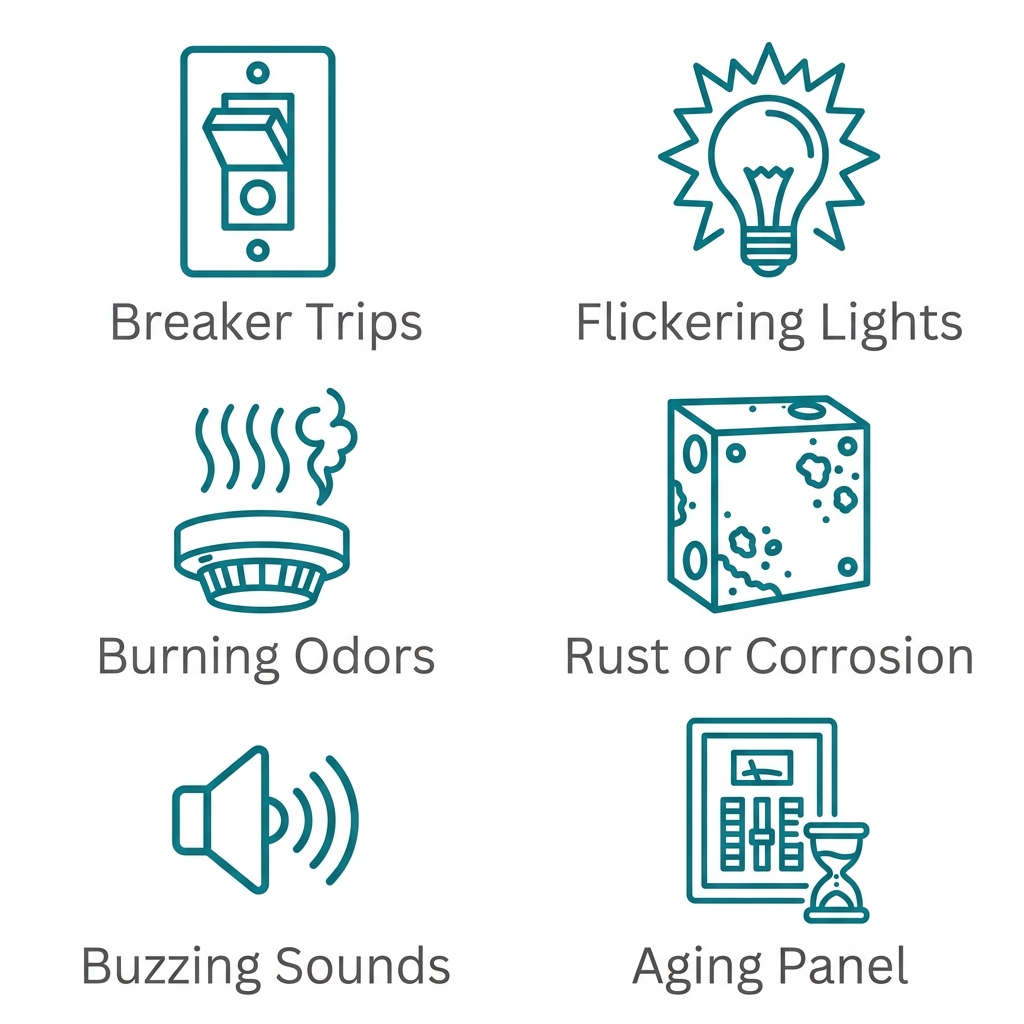
Prior to doing any work on your electrical panel, check that what you’re dealing with really requires replacing instead of fixing. Breaker trips more than twice a month, dimming or flickering lights when appliances run, and humming sounds or rust near the panel indicate a problem. Burning odors or visible sparking near the panel demand immediate attention from a licensed professional.
Older panels 30 to 60 years old have higher failure rates, and outdated brands such as Federal Pacific and Zinsco have been shown to be defective and should be replaced. Replacing vs repairing is different in that replacing increases amperage, typically from 100 amps up to 200 amps, to support changing needs like electric vehicles and home office equipment, whereas fixing does not.
A professional load evaluation determines whether your property requires increased electrical capacity. Building permits are mandatory because upgrades modify the service entrance and main disconnect. Performing any diy panel repairs is very dangerous. Service conductors remain live at 240 volts even when the main breaker is off. Therefore only a licensed electrician can perform this task safely.
Step 1: Assess Your Current Electrical Panel
Before you start upgrading, check whether there’s anything wrong in the electrical panel. If there are frequent breaker trips, lights that keep flickering, or if you can see that the electrical panel gets too hot, then your system may be struggling. If you hear buzzing sounds, see rust or corrosion on the panel, or notice burning odors or sparking nearby, never ignore these — they are emergencies requiring immediate professional attention.
- Check the panel’s label for the manufacture date; panels aged 30 to 60 years face significantly higher failure risks
- Note the brand nameplate and flag legacy models like Federal Pacific or Zinsco, which are documented safety hazards
- Never open the panel yourself — the main service conductors remain live at 240 volts even with the main breaker off
Step 2: Check Income Eligibility Requirements
The first hurdle that homeowners need to clear before they get free electrical panel upgrades under California’s electrification rebates will be their income eligibility. Under the Southern California Edison Charge Ready Home plan, the bar is set at 80% of the Area Median Income (AMI) or residence in a community identified as "disadvantaged" under SB 535. Renters can also qualify with written approval from their property owner. State rebate programs under the Inflation Reduction Act apply the same standard of no higher than 80% of AMI to decide if a homeowner can receive up to $8,000 per household.
Make sure that you have got all the previous paycheck stubs or tax info if you’re moving forward. The rebate application needs formal reserve approval before the task starts. If you don’t verify your earnings in advance, it might cause a delay. If family income is below the threshold, you may receive an upgrade at no cost or a reduced charge.
Step 3: Research Available Programs in Your State
The panel rebate program will be provided through state-level agencies in many instances as well as utility companies. In that regard, it depends upon your location and any government incentives available for your particular state.
| Program | Administering Body | Maximum Panel-Related Amount | Key Eligibility Factor |
|---|---|---|---|
| HEEHRA/HOMES | California Energy Commission | Up to $8,000 (single-family) / $14,000 (per multifamily unit) | Income-qualified households; panel upgrades paired with heat pump installations |
| HOMES/HEAR | Texas Comptroller (SECO) | Up to $8,000 / up to $14,000 | Income-qualified households; programs not yet launched as of August 2026 |
| Charge Ready Home | Southern California Edison | Up to $4,200 (panel + outlets) | Income below 80% AMI or SB 535 disadvantaged community; 200-amp minimum panel |
These are comparable to free electrical panel upgrades for qualifying households, although amounts and eligibility vary by state. For more info, verify each program’s current status directly with the administering body, since launch phases and fund availability change frequently.
Step 4: Gather Your Eligibility Documentation
Make sure that before applying for an electrification rebate, or the SCE Charge Ready Home programme, you have all this information available as part of your documentation.
- Proof of income (e.g., recent pay stubs, tax returns, or program participation documents like CalFresh or Medi-Cal)
- Proof of residence or ownership, or a signed owner approval form if you rent
- Documentation of your current electrical panel (especially if you’re applying for a panel upgrade, which requires a capacity of 200 amps or higher)
- Program-specific project details, including contractor quotes and permit plans
- Any additional documentation required by the specific rebate program (verify current requirements on the official program pages)
When the documentation is set, you can create estimates for your projects and apply properly. Remember always double check your eligibility requirements prior to doing anything else, otherwise there will be gaps that might cause problems down the line when submitting them all together.
Step 5: Request Free Estimates from Licensed Electricians
If you have all your panel information and inspection notes together, reach out to licensed electricians to request a free electrical panel upgrade estimate. We can provide a quotation based on our findings during our physical visit and will give you a written document before any work is done which means no nasty surprises.
Contact a licensed electrician, describe your panel situation, and schedule an on-site evaluation. Once the inspection is complete, you’ll receive a detailed written estimate outlining the work, timeline, and total cost, including permit fees that typically start around $150. Starting panel upgrade prices begin around $1,000, so you can sanity-check any quote you receive.
Check two or three quotations to compare scope and pricing before committing. Confirm each electrician’s licence and bond status to ensure you’re working with a qualified professional.
Step 6: Verify What the Offer Actually Covers
While free electrical panel upgrades seem simple in theory, their range of services varies greatly among providers. Therefore, before signing off on anything, make sure that the proposal will include a full load analysis. That analysis will determine whether a capacity upgrade (for example, from 100 amps to 200 amps) is truly necessary for your property. In many cases, the proposals only cover replacing the existing panel while still falling short of providing any solutions to the electrical load problem. Thus, although you’ll have replaced the electrical system, there could be problems due to the fact that nothing was done to fix the root issue.
Then find out who is responsible for obtaining the necessary permits and who will coordinate with the power company to restore service and secure approvals. Last but not least, confirm what the final inspection entails and who arranges it, since unpermitted or improperly inspected work can lead to compliance problems down the line.
If you have decided on what is needed for your project, then it’s time to set up the required permissions and install everything you need.
Step 7: Schedule Permits and Professional Installation
After determining what you can get from a rebate or offer, the next steps are getting formal approval for them as well as hiring a licensed electrician to carry out the project. Most towns, including San Jose, will require an electrical permit for main service panel upgrades to ensure compliance with local codes and the California Electrical Code.
Most people hire a licensed electrician that will deal with the entire permitting aspect of the job and set up the necessary inspections for you. Most upgrades take a standard 100-amp service to a more robust 200 amp service to give you enough power in this day and age. It is extremely important to keep all of your permit and inspection papers up to date because many rebates can’t release money until they have proof of proper permits.
While being prepared upfront, unexpected roadblocks can still arise, so it’s wise to prepare for potential delays in the rebate process ahead.
Solving Common Roadblocks in the Rebate Process
When homeowners plan their electrical upgrade, they may be surprised at how much time and money it takes. Knowing what they’ll deal with in advance helps homeowners avoid wasting money, time, and effort when upgrading their panels.
A frequent issue is having wire installed in a manner that does not comply with the current codes or electrical needs. If you already have copper wires which were not harmed and are appropriately sized, the upgrade can proceed without rewiring. Otherwise, legacy panels like Federal Pacific or Zinsco, or wiring that is outdated or non-compliant, often trigger roadblocks that require immediate attention. We are sure to run diagnostics on them prior to providing estimates so as to fix problems earlier rather than later in order to keep costs down and work scheduled as planned.
Another frequent complication stems from evolving electrical codes. The 2023 NEC now mandates AFCI and GFCI protection in many living areas, which can complicate breaker selection and add roughly $320 to $800 to the project for a 40-circuit panel. Discovering these requirements late in the process can stall your timeline. We recommend confirming code expectations with both your electrician and the permitting office before work begins to avoid surprises.
There may be some unforeseen obstacles during the installation process such as outdated electrical systems or hidden wiring defects that violate building codes. These unexpected challenges often occur if you live in an old home or system hasn’t changed for years. A pre-job assessment will uncover any possible problems before you start work, which allows us to resolve those issues promptly instead of putting them off until later when things could get out of hand. After removing these potential hindrances, we can complete our panel update project more confidently.
Frequently Asked Questions
Are there programs available for a free electrical panel upgrade in California or Texas?
California offers income-qualified rebates through HEEHRA and HOMES programs, providing up to $8,000 for single-family homes and $14,000 per multifamily unit when paired with electrification projects. Texas programs remain in the planning phase as of August 2026 and are not yet available.
Do income-qualified households qualify for a free or no-cost electrical panel upgrade?
Income-qualified households in California may qualify for rebates covering panel upgrades, with amounts up to $8,000 for single-family homes and $14,000 per multifamily unit. Texas programs are not yet launched as of August 2026.
How can I find out if I am eligible for government rebates that cover electrical panel replacement costs?
Eligibility in California is determined by household income, typically at or below 80% of the Area Median Income, or residence in a disadvantaged community. Documentation such as pay stubs or tax returns is required to verify income.
Does a ‘free electrical panel upgrade’ offer typically include the cost of permits and professional installation?
Rebate programs cover panel upgrades but do not explicitly include permit fees or installation costs. Permits are mandatory and usually start around $150, while installation costs vary by project scope and are not fully covered by rebates.
What documentation do I need to prove eligibility for energy-efficient electrical panel rebate programs?
Required documents include proof of income (pay stubs, tax returns, or program participation documents like CalFresh or Medi-Cal), proof of residence or ownership, documentation of the current electrical panel, and program-specific project details such as contractor quotes.
Move Forward with Your Panel Upgrade Project
If your Torrance home has been showing warning signs like frequent breaker trips or dimming lights, the path forward is clear: have licensed professionals come out for an in-person load evaluation to assess your current capacity and future needs. Our crew does everything from permits and inspections to making sure the upgrade meets local codes and fits with future needs like EV charging or installing new, large electrical appliances. There are no hidden or secret charges for the work or any added mark-ups. We’re going to tell you up-front how much something will cost if you choose us.
From coordinating utilities all the way through installing equipment, High Voltage Electrical takes care of each part of the job. Our team has decades of experience, delivering reliable service backed by full insurance coverage. They can make any changes from increasing capacity in small ways to replacing a whole control board. Our licensed electricians prioritize safety and compliance at every stage.
Contact us today. Ask about our no-obligation consultation and find out how a properly upgraded panel can power your home safely and efficiently.
Get Your Free Panel Evaluation
You’ve now walked through the full process — assessing your panel, checking income eligibility for rebate programs like HEEHRA and SCE Charge Ready Home, and preparing your documentation. The next practical step is a professional load evaluation, since every quote depends on what an on-site inspection actually finds. Licensed electricians handle panel upgrades safely, including the 100-amp to 200-amp conversions many modern homes need for EV chargers and high-draw appliances. Permits and utility coordination are part of doing the work correctly, so choose a team that manages them for you. High Voltage Electrical offers free estimates and in-person diagnostics before any pricing is provided. Call (855) 501-7800 to schedule your evaluation and get a clear, upfront quote. Whether you qualify for a rebate or not, knowing your panel’s true condition is the smartest place to start.
Get Your Free Panel Evaluation