
Table of Contents
- When Insurance Pays for Electrical Panel Work
- Sudden Perils That Trigger Coverage for Electrical Panel Damage
- Outdated Panels: Where Standard Policies Draw the Line
- Planned Upgrades: EV Charger Capacity and Code-Required Panel Work
- How a Licensed Electrician's Assessment Strengthens Your Claim
- Filing the Claim: Practical Steps for Working with Your Adjuster
- Protecting Your Home and Your Panel Investment
When Insurance Pays for Electrical Panel Work
Homeowners often ask: does homeowners insurance cover electrical panel replacement? In most cases, your policy covers the cost only when the panel fails due to a sudden, accidental covered peril such as fire or lightning. Insurers routinely deny claims when the damage traces to unpermitted work or code violations, making properly permitted electrical upgrades essential for protecting future coverage.
The ultimate decision is based upon what made the roof deck fail. If it was a sudden catastrophe, such as fire or lightning, it would be covered by their basic insurance policy. But if they just simply aged and deteriorated or were damaged because the owners did not perform any maintenance, the policy would probably not pay anything in relation to those items. The owner would have to pay all costs related to replacing those panels.
We will determine whether fire, lightning, or another sudden peril caused the roof damage, since the cause of damage determines coverage.
Key Takeaways
- Homeowners are frequently asking if their policy will pay to replace the electrical service panel when it has been damaged by fire, lightning or any other type of sudden incident.
- Homeowners insurance typically does not cover replacing an outdated electrical panel simply because it’s old.
- Often, when a home adds an EV charger, an outdated electrical panel reveals the need for a electrical panel upgrade rather than a repair.
- When an electrical panel shows signs of age or damage, timing matters.
- Homeowners’ insurance may cover electrical panel replacement if the failure was caused by a sudden accident such as fire or lightning.
Sudden Perils That Trigger Coverage for Electrical Panel Damage
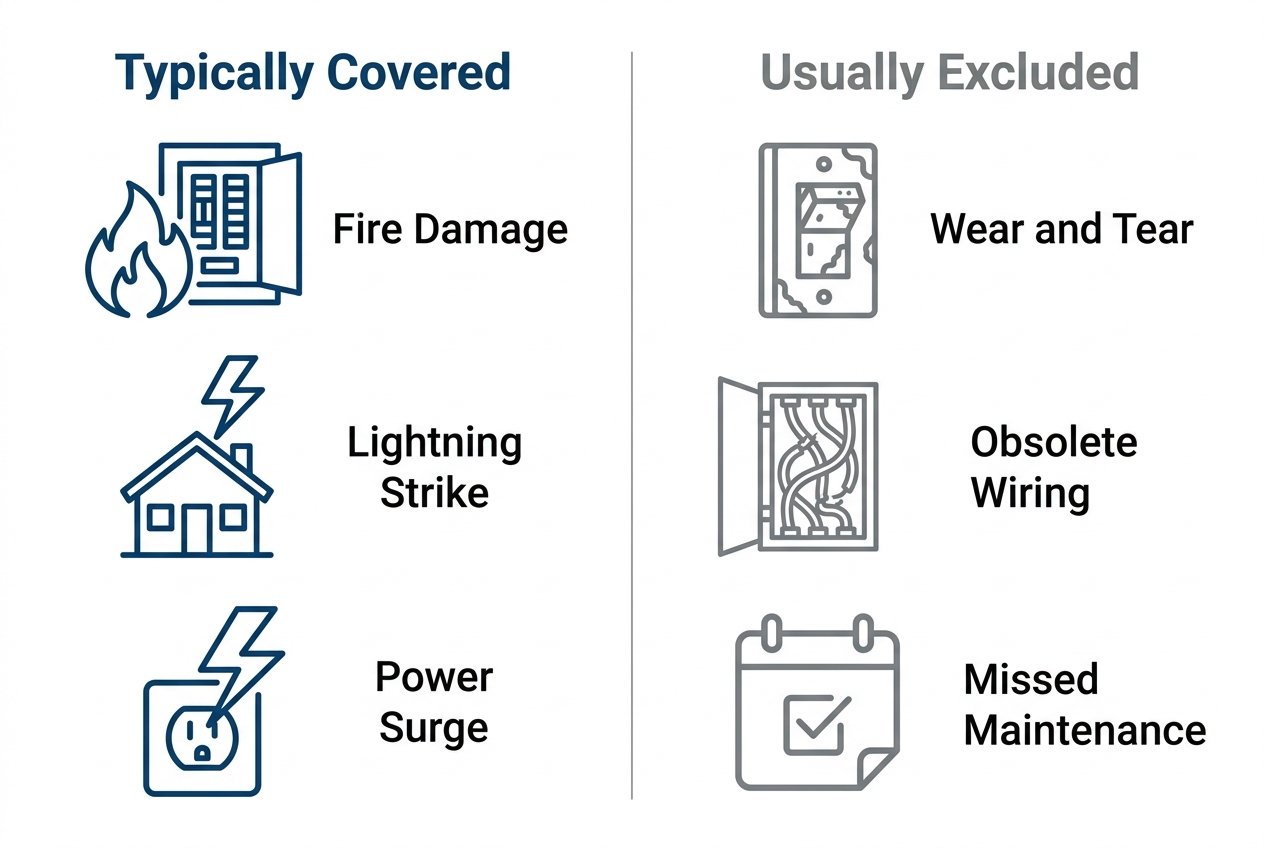
Homeowners are frequently asking if their policy will pay to replace the electrical service panel when it has been damaged by fire, lightning or any other type of sudden incident. According to industry guidance, standard homeowners insurance dwelling coverage typically pays for panel replacement only when damage stems from a sudden, accidental peril—not from long-term wear or neglect.
What Counts as a Covered Event
Fire and lightning are the most prevalent sudden perils which will provide coverage for electrical panel damage. They cause immediate, visible harm that insurers recognize as accidental and unforeseen. Power surges from external sources that overwhelm the panel in an instant may also qualify.
What Usually Falls Outside Coverage
Most insurance policies don’t cover damage that is due to normal wear and tear, outdated electrical wiring or lack of maintenance. Corrosion, frequent trips in the circuit breaker, and burning smells all mean something has been deteriorating over time and not as a result of any one incident. Houses with old wiring, especially aluminium or knob-and-tube types, face higher risks of fire hazards and may see claims denied if the panel’s age or condition contributed to the problem.
Insurance vs. Home Warranty Distinction
Warranties may cover what homeowners policies won’t. Warranties often cover electrical system issues tied to wear and tear, while standard homeowners policies typically exclude such scenarios. But home warranties generally exclude anything having to do with a power surge or lightning strike which would be covered under your homeowners policy. So there you have another reason why looking over each separately might make more sense.
We recommend scheduling annual electrical inspections and installing whole-house surge protection to minimize panel damage risk. These steps help identify hazards early and protect sensitive equipment from unexpected power spikes.
When the panels themselves have aged, coverage issues come into sharper focus and often prompt homeowners to review their choices for aging systems.
Outdated Panels: Where Standard Policies Draw the Line
Homeowners insurance typically does not cover replacing an outdated electrical panel simply because it’s old. Coverage applies only when damage results from a sudden, accidental peril like fire or lightning—not from wear, obsolete wiring, or deferred maintenance.
Most panels last 20 to 40 years before requiring replacement or upgrades, and age-related failures fall under the homeowner’s responsibility. Homes built between 1965 and 1973 with aluminum wiring face risks 55 times higher than copper-wired systems, prompting insurers to scrutinize older electrical systems closely. Whether your homeowners insurance covers electrical panel replacement for outdated equipment depends on the cause of failure, not the panel’s age alone.
Known-hazard brands such as Federal Pacific and Zinsco pose serious safety risks because they often fail to trip during fault conditions. Insurers may deny claims if investigations link fire damage to these panels or to unpermitted DIY replacements. Even if a homeowner replaces an old panel, a like-for-like swap won’t suffice—modern code compliance demands AFCI breakers, GFCI protection, and whole-home surge protective devices. In addition, replacing an outdated panel with a permitted, licensed electrician ensures compliance with the 2023 National Electrical Code and protects your claim eligibility.
Unpermitted electrical modifications, including DIY panel swaps, can void coverage entirely. Our licensed electricians handle every step, including permits, load calculations, and utility coordination, ensuring work meets NEC standards and protects your claim eligibility. Safety is our #1 priority, and proper upgrades reduce fire risks while positioning your home for lower insurance premiums.
When an outdated panel becomes a liability, the practical path is a permitted upgrade. The next section explores how EV charger capacity needs and code-required panel work factor into planned upgrades.
Planned Upgrades: EV Charger Capacity and Code-Required Panel Work
Often, when a home adds an EV charger, an outdated electrical panel reveals the need for a electrical panel upgrade rather than a repair. A 100-amp to 200-amp upgrade typically costs between $1,300 and $3,000, an investment that expands capacity while bringing the system up to modern safety standards. It accommodates high-power appliances. Beyond simply providing more power, this work ensures compliance with current codes and reduces long-term risks associated with overloaded circuits.
Whenever panels get replaced or upgraded, NEC code plays a role in it. The new installation requirements require the installation of AFCIs for residential living spaces, GFCI protection where they’re needed, and whole-home surge protective devices that help increase safety while adding to the project scope. These updates are not optional—they’re designed to prevent electrical fires and protect both the home and its occupants. Skipping them may save money upfront, but it can create significant liabilities, especially when considering insurance implications. AFCI breakers
Electrical modifications made without permission can create another, silent danger. If a fire starts and investigators link it to unpermitted work, insurers may deny the claim. On the other hand, a permitted, code-compliant upgrade creates a clear documentation trail that strengthens a homeowner’s position in the event of a future claim. The work is also likely to be up to current regulations, which means there is less chance that any changes need to be reversed later at great expense.
Even with the main breaker switched off, service entrance conductors remain energized at 240 volts, a critical detail that underscores why DIY panel replacement is dangerous. Arc flashes during such work can exceed 35,000°F, a hazard that licensed electricians are trained to mitigate through proper safety protocols and equipment. While some jurisdictions technically allow homeowners to perform this task, the risks—both physical and financial—far outweigh any perceived savings.
The specifics of any upgrade depend on the panel’s current condition and the home’s electrical load. Our licensed electricians assess these factors to recommend the safest, most efficient path forward, ensuring the work not only meets code but also supports the homeowner’s long-term goals for safety and reliability.
How a Licensed Electrician’s Assessment Strengthens Your Claim
When an electrical panel shows signs of age or damage, timing matters. A professional assessment by our fully trained technicians helps establish the cause and extent of the issue, giving you solid evidence to present to your insurer. This documented evaluation clarifies whether the damage stems from a sudden, accidental peril—such as a lightning strike or fire—or from long-term wear and tear, which most policies exclude. By connecting the panel’s condition to covered perils, the assessment supports a stronger claim and reduces the risk of denial.
Unpermitted or DIY electrical work creates additional complications. According to High Voltage Electrical’s safety guidance, turning off the main breaker does not fully de-energize the service entrance conductors, leaving live 240-volt wires that pose extreme shock and arc-flash hazards. Insurers frequently deny fire damage claims when investigations reveal unpermitted modifications, as these violate code requirements and undermine policy protections. Our licensed electricians ensure all work meets current National Electrical Code standards, including the installation of AFCI, GFCI, and surge protection devices, which insurers expect to see in compliant installations.
After we perform a comprehensive examination of the damage, our results aren’t limited to issuing an opinion, but also include providing a complete and thorough report. Our licensed electricians provide written findings, detailed photographs, and permit and inspection records that an adjuster can rely on. This documentation includes a clear cause-of-damage opinion, which helps the insurer evaluate coverage under your policy. When paired with a written estimate, this report substantiates the scope and cost of necessary repairs. That makes it easier to justify the claim.
A homeowner would be able to know in advance which expenses were covered under their homeowners’ policies if they were to go through this process. A professional assessment might help answer whether homeowners insurance can cover electrical panel replacement rather than making educated guesses. Average replacement cost of an electrical panel ranges from $520 to $2,135, but insurers typically cover these expenses only when the damage results from a sudden, accidental event—not from age or neglect. The insurer may not pay the bill if the damage was a result of aging or negligence. By documenting the panel’s condition and the cause of failure, our team helps you present a claim that aligns with your policy’s terms and increases the likelihood of approval.
Filing the Claim: Practical Steps for Working with Your Adjuster
Homeowners’ insurance may cover electrical panel replacement if the failure was caused by a sudden accident such as fire or lightning. If a licensed electrician determines the replacement was due to a covered cause, submit the documents to the insurer for review. Our staff usually sees homeowners benefit from a clear, step-by-step approach to filing and supporting their case with the adjuster.
Collect all documents needed from the insurance company: the electrician’s quote, any repair invoices and the final inspection form. These records link the panel damage to the disaster’s origin and show you’ve met the requirements. Prepare for the adjusters arrival by showing them where the panel is located, the wiring and any visible damage like burn marks or corrosion. If you have had new electrical work installed in your home, bring along copies of the permits and final inspection forms. Your insurer wants to make sure a licensed person did the job.
Expect the adjuster to scrutinize all your documents and take pictures of the panel and other components in its vicinity. They can also inquire about how old the panel is and whether any efforts have been made to maintain it. They may also ask about the panel’s age and maintenance history, since panels typically last 20 to 40 years and claims for age-related failure are often treated as maintenance issues rather than covered losses. Make sure to retain copies of whatever documentation you provide to them, and request written confirmation that the claim is under review.
Unapproved electrical work is a common pitfall that can lead insurers to deny fire damage claims even in states with strong homeowner protections like the Texas homestead exemption. Always verify that any panel work included in your claim was permitted and inspected. If your policy allows partial coverage for upgrades, submit the electrician’s invoice and inspection report to support those costs. If your policy covers up to a certain point on electric upgrades, send in the receipt of the electrician and any inspection reports showing that what you’re putting into your house works properly. A solid file now will pay off down the road.
Frequently Asked Questions
Does homeowners insurance cover electrical panel replacement if it is simply outdated or old?
Homeowners insurance typically does not cover replacing an outdated electrical panel solely because it is old. Coverage applies only when damage results from a sudden, accidental peril like fire or lightning, not from wear, obsolete wiring, or deferred maintenance.
What specific sudden perils typically trigger insurance coverage for an electrical panel replacement?
Fire and lightning are the most common sudden perils that trigger coverage for electrical panel replacement. Power surges from external sources that overwhelm the panel in an instant may also qualify as covered events under standard homeowners policies.
Will my insurance policy pay for an electrical panel upgrade if I need more capacity for an EV charger?
Homeowners insurance may not pay for an electrical panel upgrade needed for an EV charger if the requirement stems from increased capacity demands rather than damage from a sudden peril. Coverage depends on the cause of the need, not the upgrade itself.
How does an electrician’s assessment help when filing an insurance claim for a damaged electrical panel?
A licensed electrician’s assessment documents the cause and extent of panel damage, linking it to a covered peril like fire or lightning. This report, including photos and inspection records, strengthens the claim by providing clear evidence that the damage meets policy terms for coverage.
Are code-required electrical panel upgrades generally covered by standard homeowners insurance policies?
Standard homeowners insurance policies generally do not cover code-required electrical panel upgrades unless the work is directly tied to damage from a covered sudden peril. Upgrades for capacity, safety compliance, or modernization are typically the homeowner’s responsibility.
Protecting Your Home and Your Panel Investment
Homeowners insurance does cover electrical panel replacement only in certain situations, such as if the damage was caused by a fire, lightening strike or other similar occurrence. It would be considered excluded from coverage in cases of age, outdated wiring, or deferred maintenance that might cause the system to fail. Most home electrical systems have a lifespan between 20 and 40 years. Your policy typically protects against sudden, accidental perils like fire or lightning, but excludes wear, obsolete wiring, or deferred maintenance.
Our team recommends annual inspections and whole-house surge protection to safeguard both your home and your panel investment. These preventive steps help avoid uncovered claims and keep your electrical system compliant with current codes. Results may vary based on individual circumstances and building conditions.
We handle all work with licensed electricians who meet or exceed industry standards, and our services come with insurance and bonding for your peace of mind. Contact us for a panel evaluation or upgrade—we’re here to help 24/7.
Get a Professional Panel Evaluation
Now that you understand when homeowners insurance covers electrical panel replacement — and when wear or outdated equipment leaves it out of pocket — the next step is knowing the true condition of your own panel. A licensed electrician’s written assessment documents the cause of any damage and whether the panel meets current code, which is exactly what an adjuster will want to see. Since panels typically last 20 to 40 years, an aging unit is worth evaluating before it becomes a claim issue. High Voltage Electrical offers panel upgrades and safety inspections with permits and final inspections coordinated for you, so your documentation supports any future claim. Whether you’re planning an upgrade for EV charging or replacing a hazardous older panel, professional, permitted work protects both your home and your coverage. Reach out for a free estimate and take the guesswork out of your panel’s condition.