Table of Contents
- Upgrading Your Home’s Electrical System Safely
- Can You Upgrade Your Electrical Panel Without Rewiring Your House?
- Signs You Need an Electrical Panel Upgrade
- Cost Factors and Budgeting for Your Panel Upgrade
- The Panel Upgrade Process: From Assessment to Completion
- Safety, Code Compliance, and the Role of Professional Electricians
- Ensuring a Safe and Code-Compliant Electrical Panel Upgrade
Upgrading Your Home’s Electrical System Safely
You can upgrade your electrical panel without rewiring your house, and a professional installation that includes an on-site load evaluation and permit coordination ensures safe, code-compliant results. Modern homes demand more power for electric vehicles, high-draw appliances, and advanced climate systems, making panel upgrades a critical safety upgrade. At High Voltage Electrical, we begin with a thorough load evaluation that inspects the electrical service conductors and overall capacity, then manage permits and complete the installation while coordinating with local utilities. This often means moving from a 100-amp service to a 200-amp panel, future-proofing your home’s electrical system. Our pricing is transparent with NO HIDDEN FEES, and upgrades start at $1,000 plus permits from $150. We often hear from homeowners who wonder whether upgrading the panel means rewiring the whole house, and the answer depends on your existing wiring’s condition.
Key Takeaways
- It’s possible to upgrade the electric panel without rewiring your entire home.
- A 100-amp electrical panel was sufficient for homes built in the 1970s, but modern demands from central air conditioning, electric vehicles, and home offices routinely exceed its capacity.
- An electrical panel upgrade follows a set procedure, from assessing the load on site to inspecting the final stage and reconnecting power.
- The need for the panel upgrades bring up a lot of important questions about things like electrical codes.
- The final stage of any electrical panel upgrade lies in its safe, code-compliant execution.
Can You Upgrade Your Electrical Panel Without Rewiring Your House?
It’s possible to upgrade the electric panel without rewiring your entire home. It depends on several conditions. A 100-200 amp upgrade doesn’t include changing any wires inside walls in all situations because whether you will need this or not can be defined only after evaluating how much load flows through the circuit and whether the wiring complies with NEC.
According to the Electric Panel Upgrade Authority, NEC Article 230 states that single-family dwellings must have at least a 100 amp service, and upgrading from 100 to 200 amps is a common way to support increased loads. However, this doesn’t always mean you’ll need new wire throughout your home if what you currently have is copper, undamaged, and properly sized; expanded AFCI and GFCI requirements in the 2023 NEC primarily affect breaker selection rather than forcing rewiring.
However, certain conditions demand rewiring. Legacy panels from Federal Pacific or Zinsco are frequently flagged by inspectors and necessitate full panel replacement; if the connected wiring is also compromised, rewiring may be necessary. Aluminum wiring, knob-and-tube construction, or deteriorating insulation automatically trigger the need for new circuits. Undersized conductors cannot handle increased amperage and must be replaced.
High Voltage Electrical’s evaluation will determine if your home can support a panel upgrade. Licensed electricians test for any code violations, look at the condition of wires, test whether your panel is compatible, verify grounding and bonding in accordance with NEC Article 250, and make sure service entrance equipment can handle the increased load. Also, if you have a solar installation, the 120% rule applies; this typically influences panel sizing rather than requiring new wiring. We coordinate all permits and inspections, ensuring every upgrade meets California’s adopted NEC standards.
This will make it possible for you to see the signs when it might be time for a panel upgrade in your home. If your breakers trip frequently, if light bulbs are flickering off and on, or if you depend on multiple power strips, then it’s time to get a professional assessment. We recommend scheduling an evaluation with High Voltage Electrical to examine your panel, wiring, and electrical demands. This no-obligation assessment provides a clear roadmap, answering definitively whether your home can benefit from a straightforward panel upgrade or requires a more extensive rewiring solution.
Signs You Need an Electrical Panel Upgrade
A 100-amp electrical panel was sufficient for homes built in the 1970s, but modern demands from central air conditioning, electric vehicles, and home offices routinely exceed its capacity. That’s why we frequently hear homeowners asking, “How do I know if I need to upgrade my electrical panel?”
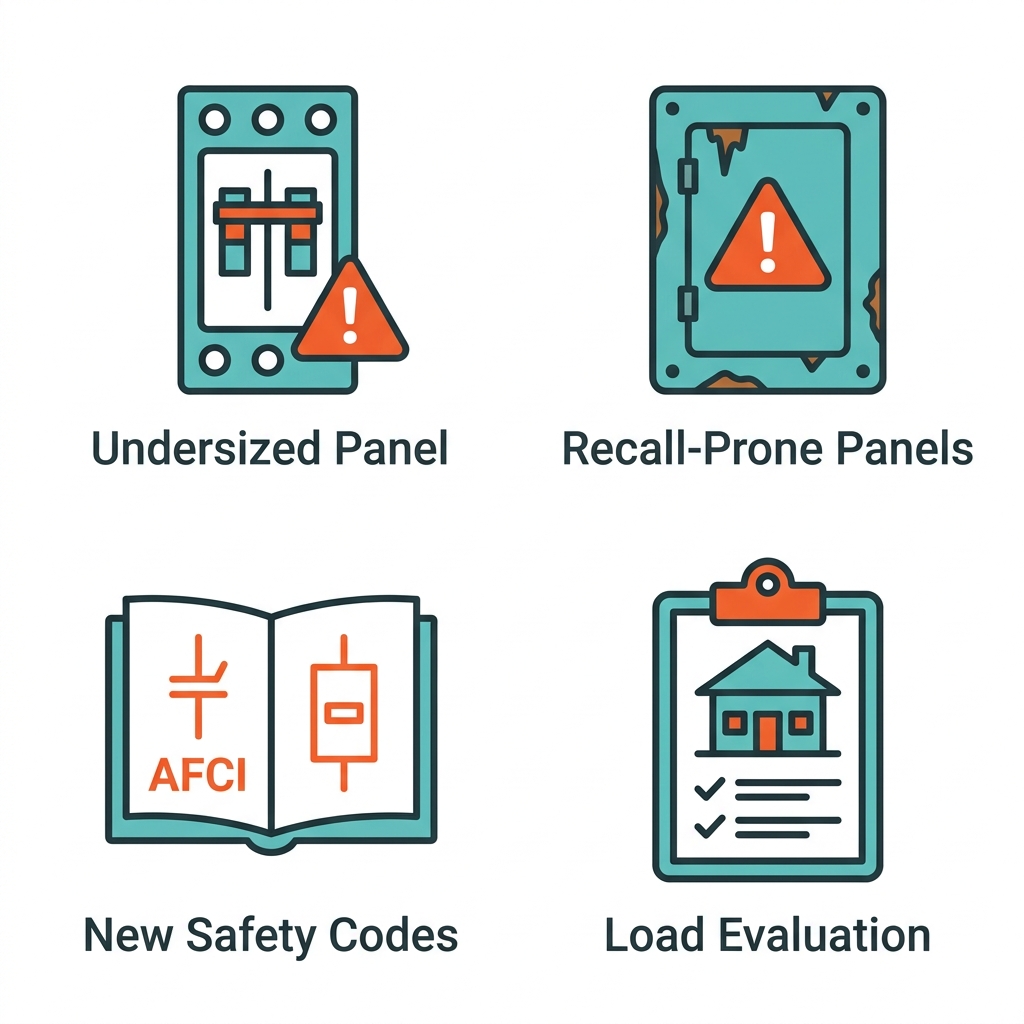
- Undersized service (100 amps or less). Homes with 100-amp service or less often experience frequent breaker trips when running major appliances at the same time. A 100-amp panel can typically deliver only 80 amps of continuous power, and a single modern suite of appliances—including an electric range, HVAC system, and laundry equipment—can draw more than that simultaneously.
- Legacy panels (Federal Pacific and Zinsco). Federal Pacific and Zinsco breakers, installed in millions of homes from the 1950s to the 1980s, have documented failure modes that prevent them from tripping under overload conditions. The Electric Panel Upgrade Authority notes that these panels are regularly flagged by inspectors, and because manufacturers are defunct, replacement breakers are nearly impossible to find. Safety is our #1 priority; we consider these panels a mandatory replacement, not an option.
- Expanded AFCI and GFCI requirements. The 2023 National Electrical Code now requires arc-fault and ground-fault circuit interrupters in kitchens, laundry areas, basements, and many other living spaces. Vintage panels often lack the neutral-bar configuration and listed breaker compatibility to accept AFCI or GFCI breakers, so a panel change is required to achieve full code compliance and protect every circuit.
- Professional load evaluation. Only a thorough, on-site load evaluation can confirm whether your panel is undersized. Our electricians perform load calculations per NEC Article 220, factoring in every connected load and future expansions like a second EV charger or pool equipment. It’s the single most reliable step before committing to any upgrade project.
This would mean that you need to consider the cost factors and budget for a panel upgrade if any of these signs apply to your home.
Cost Factors and Budgeting for Your Panel Upgrade
A transparent budget when upgrading your electrical panel must include a detailed cost list that covers the basics such as labor, permits, and any new rules from your city, so that you can know what your money will be going towards in terms of making sure you have a safe system.
In addition to this, our professionals will perform a complete load evaluation, coordinate your permits through your city’s building department, arrange the meter disconnect/reconnect with your utilities company, and handle all communication in regards to the permitting agency, which means you don’t have to worry about multiple parties.
In many cases this means moving a 100 amp electrical service up to a 200 amp service in order that the home can handle charging an electric vehicle, cooking using induction cooktops and operating multiple zones of HVAC at once. In general we won’t know how much electricity the property will actually be able to carry until we inspect it as part of our quote, so when performing upgrades like these, you’ll always be paying only for what your home needs.
A question arises as to whether installing a new electrical box necessitates re-wiring all houses; in most cases this is not required but there could be exceptions based on existing conditions and region.
Our prices are straightforward from the start. The minimum amount for installing a base panel will be around $1,000, while additional city permits could begin at approximately $150. Note that these fees differ depending on your location; for example, for an upgrade in Tampa, we verify the exact fee as part of our service.
It can also have a significant influence on your total budget. The Electric Panel Upgrade Authority claims that according to Article 230 of the National Electrical Code (NEC), all one-family dwellings need at least 100-ampere service. Therefore, if you’re upgrading the panel to meet this requirement, you’ll be meeting the base code requirements.
There have been additional AFCI and GFCI protection requirements added to NEC 2023 for some locations inside buildings such as kitchens & laundry rooms. This change can cost between $8 to $20/circuit, which adds up to around $320 to $800 if you’re doing a whole new 40 circuit breaker panel install. Factor this in when planning your project.
Home inspectors regularly bring up issues with old wiring boards like Federal Pacific and Zinsco for good reason. If your home contains one, replacing it becomes a necessary line item, adding cost but eliminating a serious safety risk.
Once you have your budget in order, the next step will be the upgrade process. From the first steps of assessment until final completion our team will be there for all installations as we back them up with a 100% satisfaction guarantee.
The Panel Upgrade Process: From Assessment to Completion
An electrical panel upgrade follows a set procedure, from assessing the load on site to inspecting the final stage and reconnecting power.
Step 1: Load Evaluation
All projects begin with an exhaustive load check that measures what is presently occurring in your home and determines if there is enough load in order for you to be able to accommodate items such as modern appliances, electric car charging units & climate control. In most older homes, we take customers from their base starting point which is about 100 amp service up to approximately 200 amps based on the usage profile. During this assessment, our electricians inspect the wiring to confirm it meets the required ampacity.
No: Upgrading the actual panel doesn’t mean all of the wiring in the home needs to be replaced. We’ll only replace faulty, old or undersized wire if they can’t carry more amps. This determination requires professional examination.
Step 2: Permits & Utility Coordination
According to Florida construction rules, any whole panel replacement requires a permit and inspection by the Authority Having Jurisdiction (AHJ). We will handle the whole application and inspection-scheduling process with the local building department.
We work with our local utility providers to make sure that when it’s time for us to enter your home and make repairs, the appropriate power shut-offs can take place. And if you’re located in one of those High-Velocity hurricane zones, like Miami-Dade and Broward Counties, there are special wind-load requirements that will be required on both service entrance masts and meter enclosures, which we’ll be sure to meet.
Step 3: Installation & Code Compliance
Installation day involves removing the old panel, mounting the new enclosure, and rerouting the branch circuits. Every connection follows the National Electrical Code, including the mandatory 36-inch working clearance in front of the panel. Our fully trained technicians adhere strictly to all safety protocols.
The new panel has been checked for the amps from your last load evaluation, which was generally a good amount at 200 amps. After wiring is done, we label circuits clearly and double-check torque specifications. We take pride in our work. Each installation is backed up with a 100% satisfaction guarantee.
Step 4: Final Inspection & Reconnection
After installing correctly, the inspector checks that everything meets the standards in codes. The utility reconnects service, and we walk you through the panel operation, breaker labeling, and maintenance tips.
All this – from starting to finishing – delivers additional electrical capacity and peace of mind.
Safety, Code Compliance, and the Role of Professional Electricians
The need for the panel upgrades bring up a lot of important questions about things like electrical codes. There are rules put out by something called NEC (NFPA 70), which is a publication of the National Fire Protection Association. Then those rules become enforced if they’re adopted by a state or local government entity known as the authority having jurisdiction. They will have ultimate decision making power here. This set of guidelines is usually updated every three years. However, sometimes old editions can get carried over and end being applied instead of new codes.
NEC Article 230 requires at least 100-ampere services for one-family dwellings, however, the 2023 NEC has added arc fault(AFCI) and ground fault(GFCI)protection to additional indoor locations such as kitchens and laundry spaces, which may add approximately $8-$20 per circuit in materials. The AFCI and GFCI advanced circuit interrupters detect dangerous arcs and ground faults before they start fires or cause electric shock. They are a crucial defense against the roughly 46,700 annual home structure fires attributed to electrical failures. Many legacy panels such as Federal Pacific Stab-Lok and Zinsco are frequently flagged by inspectors because of documented failure modes that compromise over-current protection.
In FL, The Florida Building Code adopts the 2017 NEC w/ some FL specific additions. Full panel replacement requires permits & passes inspections locally. Working with your contractor here on knowing all of the local requirements will help prevent delays. Some HVHZ like Miami-Dade and Broward Counties have requirements that require added wind-load specifications to the service masts and meter enclosures. Section NEC 110.26 says you need at least 36" in front of the residential panels to meet the safety standard for working clearances.
Professional electricians are essential to staying compliant in all ways. At High Voltage Electrical, licensed local electricians you can trust approach every job like their own personal safety project. They have learned to navigate National Codes and Local Codes alike while performing in-depth load calculation, ensuring everything is grounded and bonded according to Article 250. Additionally, we can take care of the whole permitting and inspection process. With over two decades of electrical experience behind us, our primary focus is on safety, which means that we’ll bring you both peace-of-mind along with a code-compliant installation.
If you follow both national and Florida-specific codes and rely on qualified professionals, you ensure your home’s electrical system operates reliably for years to come.
Frequently Asked Questions
How much to upgrade an electrical panel from 100amp to 200amp?
Upgrading an electrical panel from 100 amps to 200 amps with High Voltage Electrical starts at $1,000 plus permits from $150. Typical replacement costs for this upgrade range from $2,000 to $5,000 plus permit fees. A professional load evaluation determines the exact price based on your home’s wiring and local code requirements.
How much does it typically cost to upgrade an electrical panel?
Typical electrical panel upgrade costs range from $2,000 to $5,000 plus permit fees. High Voltage Electrical provides upgrades starting at $1,000 with permits from $150. The final cost depends on the amperage, existing panel condition, and any additional work required to meet current electrical codes.
Breaker box upgrade cost
A breaker box upgrade typically costs between $2,000 and $5,000 plus permit fees. High Voltage Electrical offers panel upgrades starting at $1,000 with permits from $150. The price reflects a load evaluation, equipment, labor, and coordination with local utilities and building departments.
Cost to upgrade electrical panel to 200 amps
Upgrading to a 200-amp electrical panel with High Voltage Electrical starts at $1,000 plus permits from $150. The typical cost for a 200-amp upgrade ranges from $2,000 to $5,000 plus permit fees, depending on site conditions and any needed code compliance updates identified during the load evaluation.
Cost to upgrade electrical panel to 100 amps
High Voltage Electrical’s panel upgrades start at $1,000 with permits from $150. A 100-amp upgrade, such as bringing an older home up to the minimum code requirement, falls within this starting price. The final cost is confirmed after a load evaluation and assessment of the existing service entrance and wiring.
Ensuring a Safe and Code-Compliant Electrical Panel Upgrade
The final stage of any electrical panel upgrade lies in its safe, code-compliant execution. We manage every detail, from load evaluation and permit coordination to ensuring installations meet the National Electrical Code. The Electric Panel Upgrade Authority notes the NEC requires a minimum 100-ampere service rating for dwellings under Article 230, and inspectors flag legacy panels such as Federal Pacific for failing to meet modern AFCI and GFCI requirements. All work we perform meets or exceeds these electrical codes and industry standards.
If you are wondering can i upgrade my electrical panel without rewiring my house, the answer depends on your home’s wiring; our licensed, bonded electricians can evaluate your situation, manage permits and utility coordination, and maintain insurance and bonding. Results may vary based on individual circumstances and building conditions. We provide emergency service 24/7. Contact High Voltage Electrical to schedule your panel upgrade and ensure your home’s electrical system is prepared for modern demands.
Schedule Your Panel Evaluation
Now that you understand when a panel upgrade can be completed without a full rewire, the next step is a professional assessment of your home’s electrical system. High Voltage Electrical performs on-site load evaluations to determine exactly what capacity your house requires, often transitioning from 100-amp to 200-amp service. Our licensed electricians coordinate all permits and utility communication so the work meets code from start to finish. The base cost for a panel upgrade starts at $1,000, with permit fees beginning at $150, giving you a transparent starting point for budgeting. We back every installation with a 100% satisfaction guarantee because your safety and peace of mind matter to us. A quick evaluation is the most reliable way to get an accurate, personalized quote. Let our team provide the expert guidance that turns your research into a real plan.
Schedule Your Panel Evaluation