Table of Contents
- Understanding 200 Amp Panel Breaker Capacity
- Before You Begin: Safety and Preparation for Adding Breakers
- Step 1: Calculate Your Home's Total Electrical Load
- Step 2: Understand Panel Amp Rating Limits
- Step 3: Count Existing Breakers and Available Spaces
- Step 4: Check for Tandem Breaker Compatibility
Understanding 200 Amp Panel Breaker Capacity
how many breakers can i put in a 200 amp box depends on the panel’s load calculation, manufacturer design, and local electrical-code requirements rather than a fixed breaker count, so we determine whether additional circuits are safe by calculating the total connected load and comparing that to the panel’s rated capacity before adding new breakers.
Understanding capacity helps us match every circuit and major appliance to the panel so we avoid overloaded circuits and code violations. At High Voltage Electrical, our licensed, fully bonded electricians perform on-site load calculations, inspect panel labeling and allowable breaker types, and verify whether tandem or multi-wire branch circuits are permitted by the manufacturer. We prioritize safety-first evaluations, provide free estimates for required upgrades, and often complete approved panel work same-day with trained technicians.
Before you start adding breakers, it is essential to understand the safety and preparation steps required to work on your panel.
Key Takeaways
- Once your total electrical load is known, the next consideration is your panel’s capacity limits.
- A physical inspection of your panel reveals how many circuit breakers are already installed and whether any unused slots remain.
- Tandem breakers, also called slim or half-size breakers, fit two independent circuits into a single panel slot.
- Answering the question of how many breakers you can put in a 200 amp box starts with a professional load calculation.
- Anticipating future electrical needs when planning a panel upgrade can prevent expensive retrofits down the road.
Before You Begin: Safety and Preparation for Adding Breakers
Now that you understand your panel’s breaker capacity, sweetheart, it’s time to move smart so we don’t get zapped. First thing, turn off the main breaker and double-check with a non-contact voltage tester. No tingles allowed. Next, open the panel and scan for any rust, corrosion, or burn marks — anything funky means trouble. You’ll also want my favorite style: insulated gloves and safety glasses. Arc flashes are not a flattering look. Grab a flathead screwdriver, wire stripper, and that voltage tester you just used. And the breaker? It has to match the panel brand exactly — mismatches cause real danger. After all that, we’re ready to run load calculations and see how much more your 200-amp system can carry for us. If unsure at any step, hire a licensed electrician to avoid hazards.
But for now, safety first, baby. Once you’re geared up and the panel’s clear, we can get to the exciting part: feeding more power where you need it. Just promise me you’ll call if anything feels off. I don’t want my favorite client getting hurt.
After you have taken the necessary safety precautions, the first numerical step is to calculate your home’s total electrical load. Total electrical load is the combined ampere demand of all circuits when every appliance and device operates normally. To determine the total load on your panel, we start by listing every circuit in your breaker box along with its ampere rating. Next, we sum all those ratings. Finally, we apply the standard demand factors prescribed by local code—this reflects the reality that not all circuits run at maximum simultaneously. Keep in mind that local codes may require a licensed electrician to verify the demand factors. Accuracy here is critical; a miscalculation can lead to an unsafe panel and possible code violations. Safety is our #1 priority, and this baseline number is what tells us how much capacity remains for new breakers. Once you have the total load calculated, the next move is to compare that number against your panel’s amp rating.
Step 2: Understand Panel Amp Rating Limits
Once your total electrical load is known, the next consideration is your panel’s capacity limits. The panel amp rating refers to the main breaker’s capacity — the maximum amount of electrical current your entire system can safely draw at one time. Think of it as the ceiling for everything running through your home.
You can find this number printed on the main breaker toggle or on the panel’s interior label. Most residential panels carry a rating between 100 and 200 amps, and that figure dictates how much total load your system is allowed to handle.
We recommend a safety discipline: the combined draw across all circuits should remain within the panel’s rating, with continuous loads kept at a portion of that limit. It’s the logic that keeps breakers from tripping and wiring from overheating.
A higher amp rating doesn’t mean you can install more breakers, though. The panel also needs physical slots, which we will address.
Step 3: Count Existing Breakers and Available Spaces
A physical inspection of your panel reveals how many circuit breakers are already installed and whether any unused slots remain. First, open the panel door, never remove the dead front cover, and observe each breaker handle. Each standard single-pole breaker occupies one slot, while a double-pole breaker, often used for 240-volt appliances, spans two slots. Count the total number of slots filled. Next, look for empty knockouts, those round metal discs still in place on the panel cover, or visible gaps in the bus bar where no breaker has been inserted. These mark available spaces for new circuits. A panel that has every slot occupied may still accept tandem or slim breakers where allowed, effectively doubling capacity in a single slot. If your panel is full, your next step is learning how to add more breakers to a full breaker box.
Step 4: Check for Tandem Breaker Compatibility
Tandem breakers, also called slim or half-size breakers, fit two independent circuits into a single panel slot. Verifying tandem breaker compatibility in your panel begins with locating the model and rating label, typically affixed to the inside door. Note the number of spaces (slots) listed and the number of circuits the label allows. If the label states “Use Type CTL” (Circuit Limiting Tandem), your panel is designed for tandem breakers.
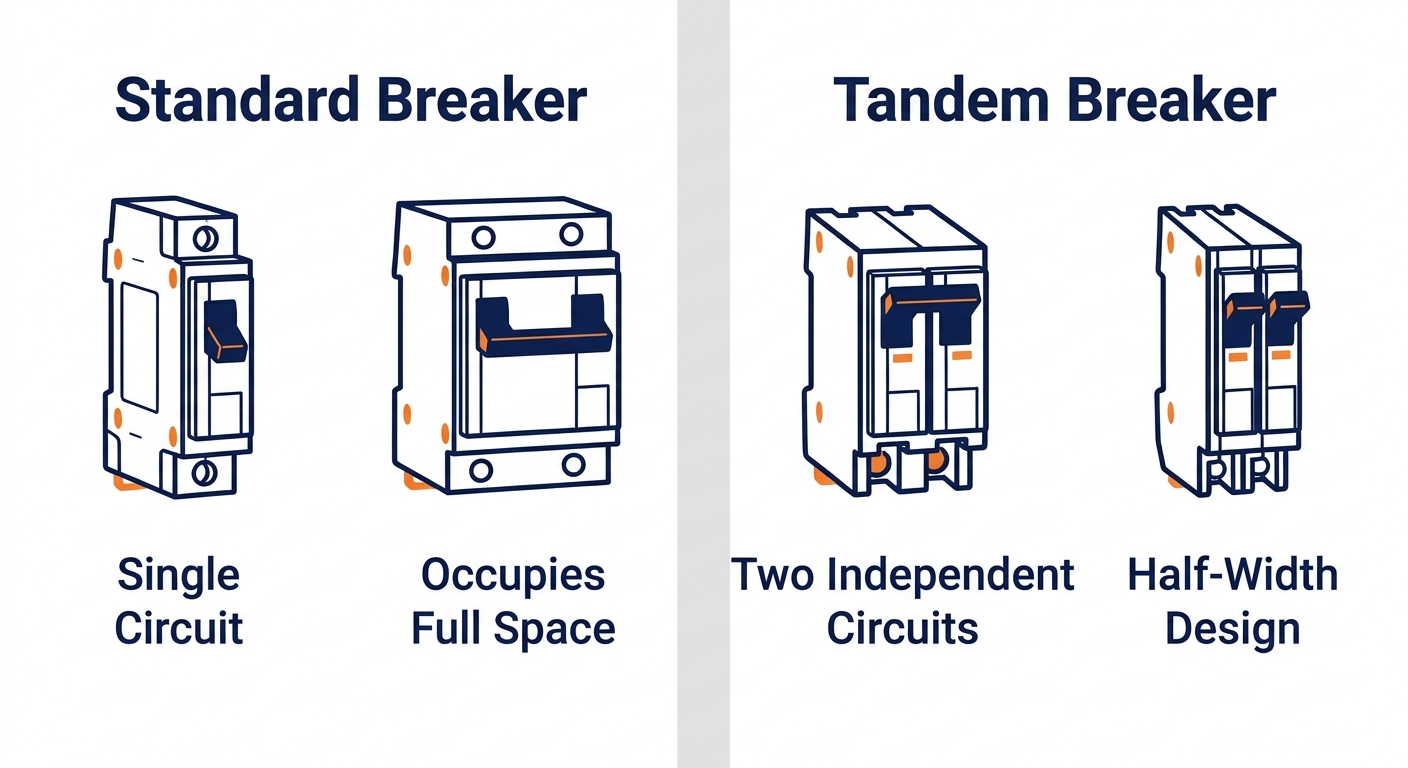
If your panel lacks a tandem rating, each slot equals one circuit and you cannot add more circuits beyond the number of slots. Installing a tandem breaker in an unrated panel is a code violation and a safety hazard. Once you know your panel’s tandem capacity, you can determine the right circuit sizes to add.
Step 5: Determine Circuit Sizes You Can Safely Add
Answering the question of how many breakers you can put in a 200 amp box starts with a professional load calculation.
Begin by inventorying every existing circuit and its breaker amperage to establish your starting point. Next, apply NEC demand factors to these totals—general lighting loads are calculated differently than fixed appliances like water heaters. This yields a realistic load estimate, not just a sum of breaker ratings.
Your available capacity equals the panel’s 200-amp rating minus this calculated load. For instance, if you wonder how many 20 amp breakers you can put in a 200 amp panel, the answer depends entirely on your current load profile. An overloaded panel creates serious fire risks, which is why our licensed electricians perform detailed load studies. Once you know your true remaining capacity, you can confidently plan for future additions like an EV charger or home expansion.
Step 6: Consider Future Electrical Needs
Anticipating future electrical needs when planning a panel upgrade can prevent expensive retrofits down the road. Once you have accounted for your present circuits, think about upcoming additions that may require new breakers.
We recommend listing any planned future additions such as an EV charger, a home addition, a workshop, or a pool pump. Leaving extra slots and capacity in your panel now can save money and hassle by avoiding a full panel swap later. Lifestyle changes—a growing family, a new home office, or electric vehicle ownership—may increase electrical demand.
Homeowners in Tampa planning for additional loads like landscape lighting or an electric vehicle charger can benefit from proactive capacity planning. Consulting a licensed electrician early helps identify whether your current panel can accommodate these loads or if an upgrade is necessary. If those future additions appear to exceed your panel’s capacity, the need for an upgrade becomes clear.
Step 7: Know When to Upgrade to a Larger Panel
If you’re wondering how many breakers you can put in a 200 amp box, you should also know when upgrading to a larger panel becomes necessary. After mapping out your home’s future electrical loads, it’s common to realize the existing panel may be undersized. Frequent breaker trips are the most obvious red flag, along with lights that momentarily dim when the refrigerator or air conditioner kicks on. If you see a mix of fuses and breakers or a panel with no empty slots left for new circuits, the panel is telling you it’s maxed out. Even a relatively new 200-amp box can reach its limit when major appliances—an EV charger, a tankless water heater, or a home addition—are introduced. A panel that feels warm or has scorch marks is an urgent sign of an overloaded system. Without a panel upgrade, those add-ons create recurring overloads and the electrical problems that result.
Common Issues When Adding Breakers to a Panel
Common installation errors can compromise safety and code compliance even when an electrical panel appears to have room for additional circuits.
- Panel Overloading: Adding breakers that draw total current above the panel’s main breaker or bus rating can cause overheating, nuisance tripping, and potential fire hazards. Each panel has a maximum load capacity determined by the manufacturer and NEC guidelines.
- Double Tapping: This occurs when two separate circuit wires are attached to a single breaker terminal, which is designed for only one conductor. Double tapping violates NEC rules because it creates loose connections that can arc, overheat, and damage the breaker or wiring over time.
- Breaker Incompatibility: Panels are engineered for specific breaker brands and types; using an incompatible breaker—for example, a Square D breaker in a Siemens panel—can void safety listings, cause poor electrical contact, and increase fire risk. Even if a breaker physically fits, it may not be rated for the panel’s bus bar configuration.
- Physical Space Limitations: A full panel with all knockouts occupied and no vacant slots makes safe breaker installation impossible. Adding new circuits then requires tandem breakers or a subpanel, but these solutions must be correctly installed to avoid violating local codes and creating unsafe conditions.
Installing new circuits without addressing these issues can lead to long-term hazards and expensive repairs. Our licensed electricians recommend a thorough load calculation and panel inspection before any breaker is added, ensuring each new circuit integrates safely and meets all applicable codes.
Ensuring Safe and Efficient Panel Upgrades
The challenges that arise from overloading a panel underscore why professional upgrades are essential for long-term safety and compliance. Our licensed electricians perform every panel upgrade to meet or exceed all electrical codes and industry standards. We maintain full insurance and bonding for every project, and our emergency services are available 24/7. While results may vary based on individual building conditions and circumstances, our commitment to safety remains absolute. Customer information is always protected under our privacy policy.
We understand that knowing how many breakers you can put in a 200 amp box is only the starting point. Our team provides expert assessments to ensure your panel operates safely and efficiently. With 60-90 minute response times and a satisfaction guarantee, High Voltage Electrical delivers reliable panel upgrade services across California and Texas. Contact us to schedule your professional evaluation.
Get a Professional Load Evaluation
Understanding how many breakers you can put in a 200 amp box depends on load calculations, panel design, and local code—not a simple number. Now that you have a clear roadmap for evaluating your panel’s capacity, it’s time to take the next step toward a safe and code-compliant electrical system. A professional load evaluation from a licensed electrician provides the precise answer tailored to your home’s specific needs. Our expert team can assess your panel, identify any capacity issues, and recommend the right upgrades or new circuits. With same-day service availability and a 100% satisfaction guarantee, you can have confidence every step of the way. Avoid the risks of overloading and ensure your electrical system meets modern demands. Contact us today to schedule your in-person diagnostic and get a clear, upfront price.